


Quick-release couplings for hose and pipe: one pull of the lever and the joint is open, with no tools at all. For fluid transfer, loading and unloading, and temporary lines — eight types that pair up to suit the ends you already have.
State size & mating type, temperature, material, fluid and pressure — quotes within 2 working hours.
| Standard | EN 14420-7 — interchangeable with the American standard |
|---|---|
| Range | 1/2″ to 4″ |
| Pressure | To 250 PSI — by size & material |
| Types | A · B · C · D · E · F · DC · DP |
| Bodies | SS316 · aluminium ZLD104 · brass HPB57-3 |
| Seals | NBR · EPDM · Viton · PTFE |
| Ends | Threaded (NPT/BSPT) or hose shank |
Pressure by size, temperature derating factors and seal ranges are on this page, as printed in the catalogue.
| At a glance | SS316 | Aluminium | Brass |
|---|---|---|---|
| Max PSI | 250 | 250 | 250 |
| At 3″ | 200 | 125 | 125 |
| Derates | No | From 250 °F | From 300 °F |
| Temp limit | 500 °F | 250 °F | 450 °F |
| Type | Connection | Which half |
|---|---|---|
| A | Female thread × male adapter | Adapter |
| B | Male thread × female coupler | Coupler |
| C | Hose shank × female coupler | Coupler |
| D | Female thread × female coupler | Coupler |
| E | Hose shank × male adapter | Adapter |
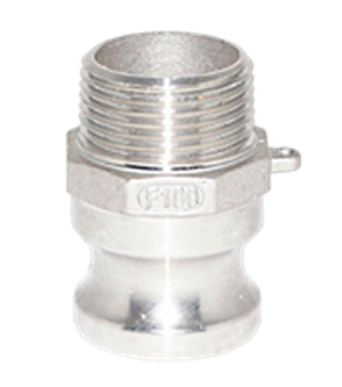
| F | Male thread × male adapter | Adapter |
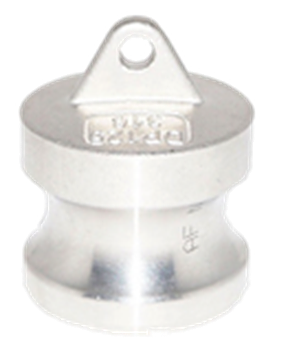
| DC | Dust cap — closes the coupler | Coupler |
| DP | Dust plug — closes the adapter | Adapter |
One joint = one coupler + one adapter. The coupler is the levered half (B, C, D, DC); the adapter is the half that goes into it (A, E, F, DP). Two couplers will not join — the commonest ordering mistake on this product. State both types when you order.
| Size | Stainless SS316 | Brass / aluminium |
|---|---|---|
| 1/2″ | 150 PSI | 150 PSI |
| 3/4″ | 250 PSI | 250 PSI |
| 1″ | 250 PSI | 250 PSI |
| 1½″ | 250 PSI | 250 PSI |
| 2″ | 250 PSI | 250 PSI |
| 2½″ | 225 PSI | 150 PSI |
| 3″ | 200 PSI | 125 PSI |
| 4″ | 100 PSI | 100 PSI |
The peak is 3/4″ to 2″ at 250 PSI — the 1/2″ is only 150 PSI, and the 4″ drops to 100 PSI in all three materials. And note 2½″ and 3″: there, stainless holds far more than brass and aluminium (225 against 150, and 200 against 125 PSI). At those two sizes the material is a pressure decision, not only a corrosion one.
Temperature derating factors
| Temperature | Stainless | Aluminium | Brass |
|---|---|---|---|
| 37.8 °C / 100 °F | 1.00 | 1.00 | 1.00 |
| 65.6 °C / 150 °F | 1.00 | 1.00 | 1.00 |
| 93.3 °C / 200 °F | 1.00 | 1.00 | 1.00 |
| 121.1 °C / 250 °F | 1.00 | 0.81 | 1.00 |
| 148.9 °C / 300 °F | 1.00 | Not offered | 0.97 |
| 176.7 °C / 350 °F | 1.00 | Not offered | 0.95 |
| 204.4 °C / 400 °F | 1.00 | Not offered | 0.92 |
| 232.2 °C / 450 °F | 1.00 | Not offered | 0.90 |
| 260.0 °C / 500 °F | 1.00 | Not offered | Not offered |
Stainless does not derate at all — the factor stays 1.00 to 500 °F. Aluminium is full pressure to 200 °F, then 0.81 at 250 °F, and not offered above that. Brass is full to 250 °F then tapers to 0.90 at 450 °F. For a hot line, this table has already made the material decision for you.
| Seal | Temperature range | For |
|---|---|---|
| NBR (Buna N) | −50…+120 °C | Oil, water, grease, air — the standard metal-coupling seal |
| EPDM | −40…+145 °C | Ozone, heat, steam, acid, alkali, alcohol — NOT for oils and greases |
| Viton | −20…+200 °C | Mineral oils, aromatics, fuels, chlorinated hydrocarbons |
| PTFE (Teflon) | −25…+100 °C | Most chemicals — but with limited flow capability |
⚠ EPDM is not for oil. It is explicitly not suitable for greases, oils and aromatic hydrocarbons — tempting though its temperature range looks. For mineral oils and fuels use Viton; for general oil, water, grease and air, NBR is enough. Name the actual fluid and we pick the compound.
Pull the locking lever, rotate both handles away from the body.
Put the adapter into the coupler until it is fully seated.
Rotate both handles toward the body. It is leak-proof when the levers are flush with the body.
Through the holes in the handles.
⚠ Line pressure is actively holding the cams down — opening the levers on a pressurised line is dangerous.
Pull the lever, rotate the handles away, withdraw the adapter, then cap the coupler (DC) and the adapter (DP).
Dust caps and plugs are not optional accessories. An open camlock is a contaminated line — the DC closes the coupler, the DP closes the adapter. They are the cheapest part on the list, and the one that decides how long the seal lasts.
Dimensions and part numbers per type are in the catalogue, as printed; stock and price are not — send the list and we confirm both.
Which coupler and which adapter — A to F, plus DC/DP if needed.
This sets the body material and the seal compound.
SS316, aluminium or brass — remember the pressures differ at 2½″ and 3″.
The fluid by name, not the category — EPDM and Viton diverge sharply on oil.
The line's working pressure, so size and material match it.
Recognised as reliable for oil and gas work — SS316 bodies with Viton seals.
PTFE seals for most chemicals — remember the limited flow capability.
Stainless bodies, seal chosen to suit the product.
Water and air lines that are broken and remade often.
Water and liquid fertiliser transfer — aluminium for light weight.
Loading, unloading and temporary lines on the quayside.
A quick-release coupling for joining two hoses or pipes — it requires no tools, and is made to EN 14420-7, interchangeable with the American standard.
One coupler and one adapter — always. Two couplers will not join. The coupler is the levered half (B, C, D, DC); the adapter is the half that goes into it (A, E, F, DP).
The peak is 3/4″ to 2″ at 250 PSI. The 1/2″ is only 150 PSI, and the 4″ is 100 PSI in all three materials. At 2½″ and 3″, stainless holds more: 225 against 150, and 200 against 125 PSI.
Stainless does not derate at all up to 500 °F. Aluminium is full pressure to 200 °F, 0.81 at 250 °F, and not offered above that. Brass is full to 250 °F then tapers to 0.90 at 450 °F.
No. EPDM is explicitly not suitable for greases, oils and aromatic hydrocarbons. For mineral oils, fuels and aromatics use Viton; for general oil, water, grease and air, NBR is enough.
Not when closed properly. It is a leak-proof connection when the locking levers are flush with the body. If a lever still stands proud, the joint has not fully closed.
Camlocks are designed to prevent loosening against vibration — and line pressure increases the locking leverage, so a pressurised joint is held harder.
Depressurise the line first. Line pressure is actively holding the cams down — opening the levers on a pressurised line is dangerous.
Yes. The DC closes the coupler and the DP closes the adapter — an open camlock is a contaminated line. The cheapest part on the list, and the one that decides how long the seal lasts.
Petroleum, chemistry, steel, medicines, food, agriculture and shipping — and they are recognised as reliable for oil and gas work.
Five things: the camlock size and its mating component, the temperature range in service, the material, the application and actual fluid, and the pressure. Those five fix the type, material and seal.
Yes — we hold this range in our regional warehouses in Singapore and Malaysia, out within 24 hours of your PO; quotes back within 2 working hours.
Related: Class 150 fittings · hydraulic quick release couplings · about the AF Hydro brand · all low pressure fittings · baca halaman ini dalam Bahasa Indonesia
