


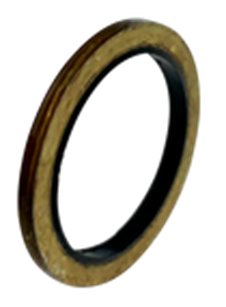
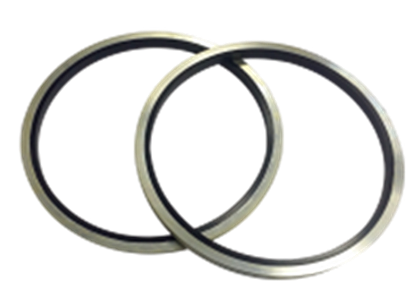
The face seal in a non-welded GS piping system: an SS302 stainless carrier ring with NBR or FPM elastomer bonded to it. It closes the joint face — the axial load is carried by the retain ring and the bolts, not by this seal.
State flange size & pipe standard, pressure class, fluid & temperature, and quantity — quotes within 2 working hours.
| Function | Seals the joint face — carries no load |
|---|---|
| Range | 1/2″ to 8″ |
| Standards | ISO 6162-2 · ISO 6164 |
| Carrier | SS302 (AISI 302) — spring-temper stainless |
| Elastomer | NBR nitrile or FPM (Viton®) |
| Pipe | ANSI B36.10 · B36.19 · metric |
| Ordered by | Flange size and pressure class |
The pressure class table, elastomer guide and failure diagnosis are on this page, as printed in the catalogue.
| At a glance | SAE 3000 | SAE 6000 | ISO 6164 |
|---|---|---|---|
| Pressure | 210–350 bar | 420 bar | 210–690 bar |
| Flanges | 1/2–3″ | 1/2–2″ | 2–12″ |
| Pressure class | Working pressure | Flange size | Pipe size range |
|---|---|---|---|
| SAE 3000 | 210–350 bar | 1/2″ to 3″ | 26×6 – 97×12 mm |
| SAE 6000 | 420 bar | 1/2″ to 2″ | 26×6 – 66×8.5 mm |
| ISO 6164 | 210–690 bar | 2″ to 12″ | 60.3×11.04 – 355.6×41.4 mm |
The normal maximum allowable working pressure is 350 to 400 bar — the 690 bar figure applies to special applications, not as a general rating. State your system pressure and we confirm the class.
Three flange types in the GS system
| System | Max pressure | Flange sizes | Seal type | Joint method |
|---|---|---|---|---|
| Retain ring | 350–400 bar (690 special) | 1/2″–3″, 2″–12″ ISO | NBR or FPM | Serrated ring grips the pipe OD |
| 37° flare | 420 bar | 1/2″–10″ | NBR or FPM | Pipe end flared at 37° |
| 90° flare | 10–40 bar | 1/2″–8″, 1/2″–24″ ANSI/JIS/BS/DIN | Fluid-dependent | Pipe end flared at 90° |
The dimensions that are measured
| Symbol | What it measures (across the metal) |
|---|---|
| ØD | Outside diameter of the metal ring |
| D1 | Inside diameter |
| S | Overall thickness |
| Component | Material | Properties |
|---|---|---|
| Carrier ring | SS302 (AISI 302) | Spring-temper austenitic stainless steel |
| Elastomer option 1 | NBR nitrile | Mineral hydraulic oil, diesel, grease, water at moderate temperature |
| Elastomer option 2 | FPM (Viton®) | Fuels, solvents, aggressive chemicals, elevated temperatures |
| Choose NBR when… | Choose FPM (Viton) when… |
|---|---|
| Mineral oil systems (the default) · diesel, grease, water at moderate temperature. Avoid: phosphate ester (HFD) fluid, prolonged ozone/UV exposure. | Temperatures above the NBR limit · fuels, solvents, aggressive chemicals. Caution: it stiffens sooner at low temperature than NBR — and is wrong for hot water or steam. |
| Feature | Bonded seal | Retain ring | Dowty seal |
|---|---|---|---|
| Function | Seals the joint face | Grips the pipe OD structurally | Seals under a bolt head or at a port |
| Carries load? | No — sealing only | Yes — structural element | No |
| Size range | 1/2″ to 8″ | 1/2″ to 14″ | 1/8″ to 3″ |
| Material | SS302 + NBR or FPM | SS302 specially treated | SS316 or steel |
| Standard | ISO 6162-2, ISO 6164 | ISO 6162-2, ISO 6164 | Inch and metric ranges |
| Ordered by | Flange size and class | Pipe outside diameter | Thread or bolt size |
| Interchangeable? | No — none of the three are the same thing | ||
The bonded seal and the retain ring are two parts of the same joint, not two names for one thing. Every GS joint needs both: the retain ring holds the flange to the pipe and carries the axial load; the bonded seal closes the face. A dowty seal is a third thing again — it seals under a bolt head or at a port.
Always new — the old one has taken a set, and its bond cannot be inspected.
For scoring and pitting. A scored face has to be refurbished, not resealed over.
A seal sitting at an angle will not close evenly all the way round.
Evenly and progressively — avoid over-torque. It is over-torque that breaks the rubber-to-metal bond.
| Symptom | Cause | Action |
|---|---|---|
| Hardened / crazed rubber | Operated above the temperature limit | Switch NBR to FPM |
| Swollen / soft rubber | Wrong elastomer for the fluid | Verify fluid compatibility |
| Rubber lifting from the metal | Bond failure — over-torque or reuse | Replace; inspect the faces |
| Scored flange faces | Installation damage | Refurbish the faces before resealing |
No hot work permit, no weld inspection, and no NDT on the joint.
The joint comes apart and goes back together for inspection and resealing.
No weld slag to flush out of the line afterwards.
Carbon steel, stainless, duplex, super duplex and titanium — in principle any pipe with elongation above 20%.
Why 20% elongation? Because that ductility is what lets the ring grip without cracking the pipe. Check the elongation figure on the material certificate rather than the grade name.

Full size tables and part numbers are in the catalogues, as printed; stock and price are not — send the list and we confirm both.
1/2″ to 8″ — and the pipe standard: ANSI B36.10, B36.19 or metric.
SAE 3000, SAE 6000 or ISO 6164.
This decides NBR or FPM.
Remember these are consumables — order spares for maintenance.
Treat it as a consumable. The elastomer has taken a set under clamping load, and the bond between rubber and metal is the part you cannot inspect. Fit a new one.
No, and they are not interchangeable. They are two different parts of the same joint: the bonded seal closes the face, the retain ring holds the flange to the pipe and carries the axial load.
1/2″ to 8″, to ISO 6162-2 and ISO 6164, in ANSI B36.10, B36.19 and metric pipe sizes. Sizes outside that range can be made to order.
The metal ring gives the seal a fixed, repeatable position and a hard stop. An O-ring needs a machined groove; a bonded seal carries its own seat.
No hot work permit, no weld inspection and no NDT on the joint. The joint comes apart and goes back together for inspection, and it is clean by design — no weld slag to flush out.
NBR for mineral oil systems; also diesel, grease and water at moderate temperature — avoid phosphate ester (HFD) and prolonged ozone/UV. FPM for elevated temperature, fuels, solvents and aggressive chemicals — but it stiffens sooner at low temperature and is wrong for hot water or steam.
SAE 3000: 210–350 bar (1/2–3″). SAE 6000: 420 bar (1/2–2″). ISO 6164: 210–690 bar (2–12″). The normal maximum allowable working pressure is 350–400 bar; 690 bar applies in special applications.
Four steps: fit a new seal; clean and inspect both faces for scoring and pitting; verify it sits flat and square; torque evenly across the diagonal in stages, avoiding over-torque.
It has been operated above its temperature limit — switch NBR to FPM. If it is swollen and soft, the elastomer is wrong for the fluid. If the rubber is lifting from the metal, that is bond failure from over-torque or reuse.
GS qualifies the retain ring method for carbon steel, stainless, duplex, super duplex and titanium — in principle any pipe with elongation above 20%, because that ductility is what lets the ring grip without cracking the pipe.
Four things: flange size and pipe standard (ANSI B36.10, B36.19 or metric), pressure class (SAE 3000, SAE 6000, ISO 6164), fluid and temperature range, and quantity.
We hold them in our regional warehouses in Singapore and Malaysia, out within 24 hours of your PO; quotes within 2 working hours.
Related: GS Hydro retain rings · dowty seals · SAE flanges · all accessories · baca halaman ini dalam Bahasa Indonesia