

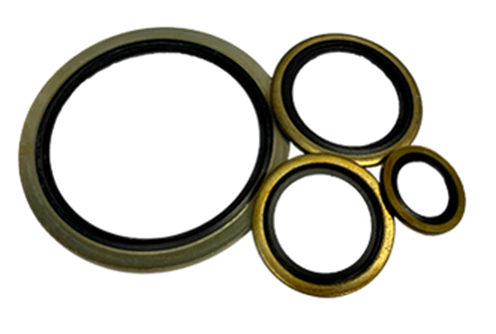

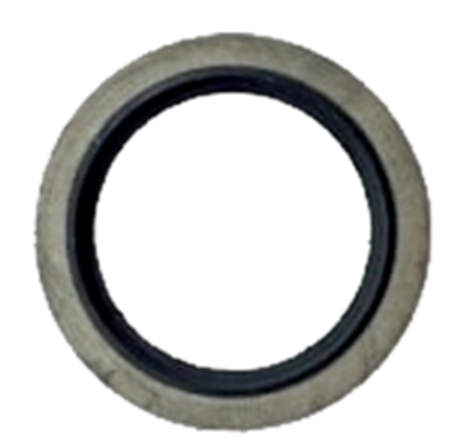
The seal under a bolt head and at a threaded port: a metal ring with nitrile rubber bonded to its inner bore. It seals on a flat face — so there is no groove to machine, and no risk of extruding the rubber, because the metal takes the load.
State the thread size (metric or BSP) and the ring material — quotes within 2 working hours.
| Construction | Metal ring + nitrile rubber bonded to the inner bore |
|---|---|
| Range | M8–M24 · 1/8″–2½″ BSP (to 3″ on request) |
| Ring | Steel or stainless steel |
| Elastomer | NBR nitrile as standard |
| Pressure | High and low pressure systems |
| Ring thickness | 1.00 to 3.20 mm across the range |
| Seating | Flat face — no O-ring groove |
The 25-size table with dimensions and tolerances, plus the torque table per thread, are on this page, as printed in the catalogue.
| Thread size | Size ref | Bore d (mm) | Lip C (mm) | Outside D (mm) | Thickness S (mm) |
|---|---|---|---|---|---|
| M8 | 866 | 8.70 | 6.40 | 14.00 | 1.00 |
| 1/8″ BSP | 820 | 10.37 | 8.26 | 15.88 | 2.00 |
| M10 | 708 | 10.70 | 8.05 | 16.08 | 1.50 |
| M12 | 867 | 12.70 | 9.73 | 19.00 | 1.50 |
| 1/4″ BSP | 821 | 13.74 | 11.18 | 20.57 | 2.00 |
| M14 | 868 | 14.70 | 11.39 | 22.00 | 1.50 |
| 5/8″ | 869 | 16.51 | 12.90 | 25.40 | 2.00 |
| M16 | 870 | 16.70 | 13.41 | 24.00 | 1.50 |
| 3/8″ BSP | 823 | 17.28 | 14.76 | 23.80 | 2.00 |
| 11/16″ | 871 | 18.16 | 14.50 | 25.40 | 2.50 |
| M18 | 872 | 18.70 | 14.76 | 26.00 | 1.50 |
| M20 | 873 | 20.70 | 16.76 | 28.00 | 1.50 |
| 1/2″ BSP | 825 | 21.54 | 18.24 | 28.58 | 2.50 |
| M22 | 874 | 22.70 | 18.74 | 30.00 | 2.00 |
| 5/8″ BSP | 826 | 23.49 | 20.27 | 31.75 | 2.50 |
| M24 | 875 | 24.70 | 20.11 | 32.00 | 2.00 |
| 3/4″ BSP | 827 | 27.05 | 23.83 | 34.93 | 2.50 |
| 7/8″ BSP | 829 | 30.81 | 27.51 | 38.10 | 2.50 |
| 1″ BSP | 830 | 33.89 | 29.92 | 42.80 | 3.20 |
| 1¼″ BSP | 832 | 42.93 | 38.45 | 52.38 | 3.20 |
| 1½″ BSP | 833 | 48.44 | 44.45 | 58.60 | 3.20 |
| 1¾″ BSP | 834 | 54.89 | 50.42 | 69.85 | 3.20 |
| 2″ BSP | 836 | 60.58 | 56.26 | 73.03 | 3.20 |
| 2¼″ BSP | 838 | 66.68 | 62.36 | 79.50 | 3.20 |
| 2½″ BSP | 839 | 76.08 | 71.50 | 90.17 | 3.20 |
Tolerances: d ±0.13 mm · D +0.13 mm · S ±0.10 mm. ⚠ Watch the metric and BSP sizes that sit close together: M16 (bore 16.70) and 3/8″ BSP (bore 17.28) are half a millimetre apart — but they do not interchange. Using an M-size seal on a BSP thread is an easy mistake to make and a hard one to see.
| Metric thread | Imperial | BSP | lbf·in | Nm |
|---|---|---|---|---|
| Up to M8 | 5/16″ | — | 47 | 5.3 |
| M10 | 3/8″ | 1/8″ | 63 | 7.1 |
| M11 | 7/16″ | — | 105 | 11.8 |
| M12 | 1/2″ | 1/4″ | 140 | 15.8 |
| M14 | 9/16″ | 0.60 × 19 | 200 | 22.6 |
| M16 | 5/8″ | 3/8″ | 270 | 30.5 |
| M18 | 3/4″ | 0.75 × 14 | 360 | 40.7 |
| M20 | 0.825″ | 1/2″ | 500 | 56.5 |
| M22 | 7/8″ | 5/8″ | 600 | 67.8 |
| M24 | 1″ | — | 650 | 73.4 |
| M27+ | 1.041″ | 3/4″ | 700 | 79 |
Over-tightening is hard here — the metal ring is a hard stop. The metal takes the clamp load, so the rubber cannot be over-compressed or extruded. Still follow the figures above: what they protect is not the seal, it is the thread.
| Metal ring | Where it goes |
|---|---|
| Steel | Enclosed hydraulics, indoor plant |
| Stainless | Washdown, marine, offshore — and exposed bolt heads |
The elastomer is NBR (nitrile) as standard, bonded to the ring's inner bore — NBR is the standard hydraulic elastomer: good with mineral oil, cheap, and stable at ordinary machine temperatures. Other compounds are available on request for aggressive media — name the fluid.
| Detail | Requirement |
|---|---|
| Radial gap (G) | Per datasheet |
| Maximum corner radius | 0.15 mm at the counterbore bottom |
| Spotface | Flat, clean, minimum size D |
| O-ring groove | Not needed — it seals on the flat face |
| ✓ Correct | ⚠ Errors |
|---|---|
| A new seal every time — it is a consumable Clean face — no sealant, paint, burrs or swarf Rubber side towards the face being sealed Centralising lip square on the shank Tighten to the specified torque figure | Fitted reversed — metal meets the face, rubber unused Adding sealant — unnecessary, and it contaminates the system Reusing seals on high-pressure ports Using an M-size seal on a BSP thread — they do not interchange Ignoring port face quality |
If a port weeps and keeps weeping after tightening, check which way round the seal went in — before replacing anything. Rubber facing the wrong way will never seal, at any torque.
| Feature | Dowty seal | GS bonded seal |
|---|---|---|
| What it seals | Under a bolt head or at a threaded port | A flange joint face |
| Size range | 1/8″ to 3″ | 1/2″ to 8″ |
| Material | SS316 or steel | SS302 + NBR or FPM |
| Ordered by | Thread or bolt size | Flange size and class |
| Interchangeable? | No — same principle, different jobs | |
They work on the same principle — rubber bonded to metal — but they are different parts for different jobs. See also GS Hydro bonded seals and retain rings.
Full size tables and part numbers are in the catalogue, as printed; stock and price are not — send the list and we confirm both.
They work on the same principle — rubber bonded to metal — but they are different parts for different jobs. A Dowty seal seals under a bolt head or at a threaded port; a GS bonded seal closes a flange joint face.
The rubber side faces the surface being sealed. Fitted reversed, it is the metal that meets the face and the rubber is never used — the commonest error on this product.
It is very difficult. The metal ring is a hard stop — the metal takes the clamp load, so the rubber cannot be over-compressed or extruded. Still tighten to the specified torque figure.
No. It seals on a plain flat face — no O-ring groove to machine. All that is needed is a flat, clean spotface at least as big as D.
Treat it as a single-use consumable. Fit a new one every time the joint is opened, particularly on high-pressure ports.
Work from the thread size — M8 to M48, or 1/8″ to 3″ BSP — or measure the bore and outside diameter and cross-reference the table on this page.
It is specified for both high and low pressure systems. The metal ring takes the clamp load, so the rubber is not extruded.
Do not. It is unnecessary — and it contaminates the hydraulic system.
NBR is the standard for mineral oil: good with mineral oil, cheap, and stable at ordinary machine temperatures. Other compounds are available on request for aggressive media.
Yes — up to 3″ nominal (DN80) on request.
Steel for enclosed hydraulics and indoor plant. Stainless for washdown, marine, offshore, and exposed bolt heads.
Our running sizes are M8–M22 and 1/8″–1/2″ BSP, held in our regional warehouses in Singapore and Malaysia, out within 24 hours of your PO.
Related: GS Hydro bonded seals · retain rings · DIN 2353 fittings · hydraulic ball valves · all accessories · baca halaman ini dalam Bahasa Indonesia
