

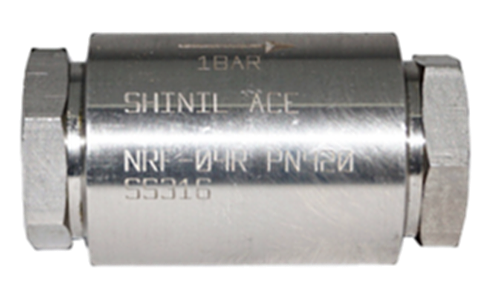
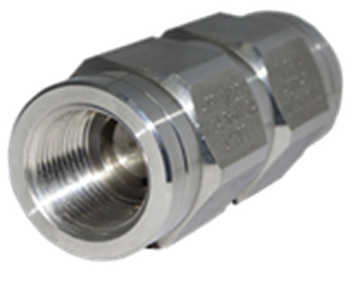
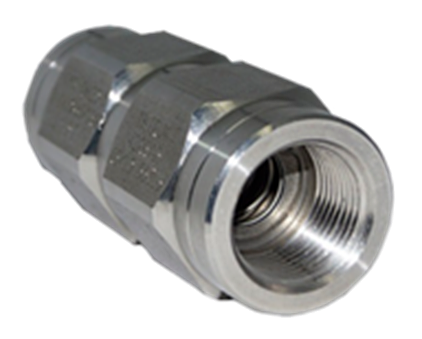
One-way flow valves for protecting pumps, holding loads, and stopping one circuit backing into another. Two ranges: MHA RV reaches 500 bar in the smaller sizes, and the Inteva 504 uses a metal closure with no O-ring in the flow path and seven cracking-pressure options.
State port & thread, working pressure, cracking pressure and flow rate — quotes within 2 working hours.
| Function | One-way flow — spring-loaded poppet |
|---|---|
| Range | 1/8″–2″ (DN6–DN40) |
| Pressure | MHA to 500 bar · Inteva 300 bar (200 bar at 2″) |
| Cracking | 0.34 · 0.5 · 1 · 2.5 · 4.5 · 6 · 8 · 10 bar |
| Body | Steel (EN 10277-3) or SS316 |
| Temperature | MHA −20…+100 °C · Inteva per seal |
| Ends | BSPP (ISO 228) · NPT · SAE J514 UNF |
Pressure by size, maximum flow, dimensions and part numbers are on this page, as printed in the catalogue.
| At a glance | MHA RV | Inteva 504 |
|---|---|---|
| Max (small) | 500 bar | 300 bar |
| Burst published | — | 1,200 bar |
| Cracking | 0.5 or 4.5 bar | Seven settings |
| O-ring | Per code | None (standard) |
MHA type RV — steel against SS316
| Port | Inch | Steel PN | SS316 PN |
|---|---|---|---|
| G1/8 | 1/8″ | 500 bar | 350 bar |
| G1/4 | 1/4″ | 500 bar | 350 bar |
| G3/8 | 3/8″ | 500 bar | 350 bar |
| G1/2 | 1/2″ | 500 bar | 350 bar |
| G3/4 | 3/4″ | 500 bar | 350 bar |
| G1 | 1″ | 500 bar | 350 bar |
| G1¼ | 1¼″ | 400 bar | 350 bar |
| G1½ | 1½″ | 350 bar | 350 bar |
| G2 | 2″ | 350 bar | 350 bar |
⚠ Stainless is rated lower, not the same. The SS316 body is held to 350 bar across the whole range while the steel reaches 500 bar in the smaller sizes. Swapping to stainless for corrosion reasons can quietly cut your pressure margin by a third — check before you change material.
Inteva 504 series — flow, pressure and burst
| Bore | Inch | Max flow | Max pressure | Min burst |
|---|---|---|---|---|
| 04 | 1/8″ | 8 l/min | 300 bar | 1,200 bar |
| 06 | 1/4″ | 26 l/min | 300 bar | 1,200 bar |
| 10 | 3/8″ | 44 l/min | 300 bar | 1,200 bar |
| 13 | 1/2″ | 90 l/min | 300 bar | 1,200 bar |
| 20 | 3/4″ | 152 l/min | 300 bar | 1,200 bar |
| 25 | 1″ | 200 l/min | 300 bar | 1,200 bar |
| 32 | 1¼″ | 370 l/min | 300 bar | 1,200 bar |
| 40 | 1½″ | 598 l/min | 300 bar | 1,200 bar |
| 50 | 2″ | 875 l/min | 200 bar | 800 bar |
The 2″ is the exception: every size from 1/8″ to 1½″ is rated 300 bar with a 1,200 bar minimum burst, and the 2″ drops to 200 bar working with an 800 bar burst. Burst figures are tested to ISO 18869.
| Range | Setting | Note |
|---|---|---|
| MHA RV | 0.5 bar (standard, all sizes) | 4.5 bar option, ordered as PÖ |
| Inteva 504 | 0.34 bar / 5 psi (standard) | All Inteva settings held to ±0.3 bar |
| 1 bar / 14 psi | ||
| 2.5 bar / 36 psi | ||
| 4.5 bar / 65 psi | ||
| 6 bar / 87 psi | ||
| 8 bar / 115 psi | ||
| 10 bar / 145 psi |
Cracking pressure is the pressure difference the inlet has to beat before the poppet lifts. There is no adjuster on either make — it is a spring inside a closed body, so the setting goes into the part number. And when brands are swapped, this is the part people most often forget to carry across.
| Type | BSPP | NPT | SAE UNF | L (mm) | i (mm) | B (mm) | Weight |
|---|---|---|---|---|---|---|---|
| RV-DN6 | G1/8 | 1/8″ | — | 45 | 9.5 | 16 | 0.10 kg |
| RV-DN8 | G1/4 | 1/4″ | 7/16″-20 UNF | 55 | 13.5 | 25 | 0.20 kg |
| RV-DN10 | G3/8 | 3/8″ | 9/16″-18 UNF | 65 | 13.5 | 30 | 0.40 kg |
| RV-DN12 | G1/2 | 1/2″ | 3/4″-16 UNF | 73 | 15.5 | 35 | 0.60–0.70 kg |
| RV-DN16 | G3/4 | 3/4″ | 1 1/16″-12 UN | 88 | 17.5 | 45 | 1.20 kg |
| RV-DN20 | G1 | 1″ | 1 5/16″-12 UN | 127 | 19.5–20 | 50 | 1.90–2.00 kg |
| RV-DN25 | G1¼ | 1¼″ | 1 5/8″-12 UN | 143 | 20–21.5 | 60 | 3.00–3.30 kg |
| RV-DN30 | G1½ | 1½″ | 1 7/8″-12 UN | 139.5–143 | 20–23.5 | 70 | 3.90–4.20 kg |
| RV-DN40 | G2 | 2″ | 2 1/2″-12 UN | 165 | 21–25.5 | 90 | 7.20–8.00 kg |
SAE UNF is available from DN8 up — the DN6 is BSPP and NPT only. Column i is the thread depth and B the hex width; check your spanner has room before fitting into a tight space.
Inteva 504 — part numbers, hex & length
| Bore | Inch | BSP ref | NPTF ref | Hex (CH) | Length (B) |
|---|---|---|---|---|---|
| 04 | 1/8″ | 504.110000AA | 504.110000BA | 14 | 42.5 mm |
| 06 | 1/4″ | 504.110001AB | 504.110001BB | 19 | 56 mm |
| 10 | 3/8″ | 504.110002AC | 504.110002BC | 22 | 67.5 mm |
| 13 | 1/2″ | 504.110003AD | 504.110003BD | 30 | 77 mm |
| 20 | 3/4″ | 504.110004AE | 504.110004BE | 36 | 90 mm |
| 25 | 1″ | 504.110005AF | 504.110005BF | 46 | 106 mm |
| 32 | 1¼″ | 504.110006AG | 504.110006BG | 55 | 125 mm |
| 40 | 1½″ | 504.110007AH | 504.110007BH | 60 | 140 mm |
| 50 | 2″ | 504.110008AI | 504.110008BI | 75 | 160 mm |
BSP is the Inteva standard; NPTF on request with a minimum quantity. The part numbers above are the standard shelf build: carbon steel, unsealed, 5 psi cracking pressure.
| Position | What it fixes — example 504.110003AD |
|---|---|
| 1–3 | Series — 504 |
| Digit 4 | Material — 1 = carbon steel, 2 = SS316 |
| Digit 5 | Closing — 1 = poppet |
| Digit 6 | Seal — 0 none, 1 NBR, 2 Viton, 3 EPDM |
| Digits 7–8 | Opening pressure — 00 = 0.34 bar, 10 = 1 bar, 25 = 2.5, 45 = 4.5, 60 = 6, 80 = 8, 99 = 10 bar |
| Digit 9 | Size — 0 = 1/8″ through 8 = 2″ |
| Letters 10–11 | Thread — A = BSP, B = NPTF; second letter = size |
Standard shelf item: carbon steel, unsealed, 5 psi (0.34 bar) build. If you need a different seal, material or opening pressure, all of it lives in the part number — not something that can be changed after delivery.
| Specification | MHA RV steel | MHA RV SS316 | Inteva 504 |
|---|---|---|---|
| Body material | Steel | Stainless | Carbon steel EN 10277-3 or SS316 |
| Closure | Poppet on seat | Poppet on seat | Metal poppet, no O-ring as standard |
| Spring | Per build | Per build | EN 10270-3 / -1 / SH |
| Seal options | Per material code | Per material code | NBR, Viton (FPM), EPDM on request |
| Temperature | −20…+100 °C | −20…+100 °C | NBR −30/+100 · Viton −10/+200 · EPDM −40/+150 °C |
The Inteva has no O-ring in the flow path as standard — and that is the main reason to choose it: nothing to swell, harden or extrude, and it takes pressure peaks better. The consequence: a metal-to-metal closure is not a soft-seated seal. If you need a genuinely tight shut-off, ask for the sealed Inteva build or put an isolating valve in the line as well.
Thread standards
| Thread | How it seals |
|---|---|
| BSPP (G) — DIN ISO 228 | Parallel — seals on a washer or O-ring, not on the thread |
| NPT — ANSI B1.20.1 | Tapered — seals on the thread itself |
| SAE J514 UNF — ISO 11926-1 | Straight thread — seals on an O-ring in the port face; available from DN8 |
They are not interchangeable, and forcing one into another damages both. Use whichever your port already is. And remember MHA's note: the valve is only ever as strong as the fitting screwed into it.
Inteva publishes the 504 as interchangeable.
Inteva publishes the 504 as interchangeable.
Inteva publishes the 504 as interchangeable.
Inteva publishes the 504 as interchangeable.
Send the old part number or a photo of the body marking on WhatsApp and we come back with the 504 reference — including the opening pressure, the part people forget to carry across when they swap brands.
For swarf, thread sealant or packing debris. Push the poppet off its seat with something blunt and let it go — it should move freely and snap back.
For burrs and damaged thread crests, before anything is screwed in.
Against the bore table and the fittings' rating — the valve is only as strong as the fitting in it.
The arrow points the way flow is allowed. Fit it backwards and you have blocked the line rather than protected it — and the symptom looks like a blockage somewhere else entirely.
There is no preferred attitude — the spring does not rely on gravity. But support the pipework so the valve is not carrying pipe weight or vibration through the threads.
If a valve is passing, the usual cause is debris on the seat rather than wear — flush the line and look through the valve before condemning it. In practice a check valve cannot be repaired: a compact one-piece body with no service kit.

Pressure-drop curves are published for both makes (MHA quotes them for a mineral oil of 880 kg/m³ at 35 mm²/s kinematic viscosity). Tell us the flow and we will read your size off it. A works certificate is available on request — ask with the order, not afterwards.
Stopping reverse flow back through a pump when the system stops.
Holding a cylinder in position if pressure is lost.
Two pumps or two circuits on one line without backing into each other.
A low cracking pressure (0.34 bar) so the charge line is not restricted.
The unsealed Inteva build — no elastomer to extrude.
SS316 bodies — remember the rating is 350 bar, not 500.
MHA states the flow direction as B to A, and the body is marked with an arrow or the check-valve symbol with lettered ports. The arrow points the way flow is allowed to pass — from your pressure source towards the load. Fit it backwards and you have blocked the line rather than protected it, and the symptom looks like a blockage somewhere else entirely.
The pressure difference the inlet has to beat before the poppet lifts. MHA RV: 0.5 bar standard, 4.5 bar option. Inteva 504: seven settings from 0.34 bar (5 psi) to 10 bar (145 psi), held to ±0.3 bar.
No. It is a spring inside a closed body and there is no adjuster on either make — the setting is chosen in the part number at order.
No, and this is the commonest ordering mistake on this product. On the MHA RV the DN figure refers to the bore, not the port thread: DN20 takes G1 or 1″ NPT, DN25 is 1¼″, DN30 is 1½″, DN40 is the 2″.
It depends on size and material, not the range. MHA RV in steel: 500 bar from DN6 to DN20, then 400 bar at DN25 and 350 bar at DN30 and DN40. Stainless RV: 350 bar at every size. Inteva 504: 300 bar to 1½″, 200 bar at 2″.
The stainless body is held to 350 bar across the whole range while the steel reaches 500 bar in the smaller sizes. So swapping to stainless for corrosion reasons can quietly cut your pressure margin by a third.
Yes. Every size from 1/8″ to 1½″ is rated 300 bar with a 1,200 bar minimum burst; the 2″ drops to 200 bar working with an 800 bar burst. Burst figures are tested to ISO 18869.
Whichever your port already is — they are not interchangeable and forcing one into another damages both. BSPP is parallel and seals on a washer or O-ring; NPT is tapered and seals on the thread; SAE UNF is a straight thread sealing on an O-ring in the port face.
Both are specified for hydraulic oil — Inteva lists the 504 for oil hydraulics (fluid Group II), and MHA quotes its flow figures for a mineral oil of 880 kg/m³. Water and water-glycol change both the material choice (stainless rather than steel) and the seal choice — name the medium.
MHA RV: −20 to +100 °C in both steel and stainless. On the Inteva 504 the limit comes from the seal: NBR −30/+100, Viton −10/+200, EPDM −40/+150 °C.
Not in the standard build. A metal closure with no O-ring in the flow path — which is the main reason to choose it: nothing to swell, harden or extrude, and it takes pressure peaks better.
A check valve is there to stop reverse flow, and neither maker specifies it as a zero-leakage isolator. A metal-to-metal closure is not a soft-seated seal — if your application needs a genuinely tight shut-off, ask for the sealed Inteva build or put a proper isolating valve in the line as well.
Inteva publishes the 504 as interchangeable with Gromelle 4000, DMIC CVH, Parker DC and Snap-tite CPIFF. Send the old part number or a photo of the body marking and we come back with the 504 reference — including the opening pressure.
In practice, no. A compact one-piece body with no service kit, and at these pressures a reworked seat is not something to rely on. If a valve is passing, the usual cause is debris on the seat rather than wear — flush the line and look through it first.
A works certificate is available on request — ask for it with the order rather than afterwards, while the batch is still identifiable. Inteva also publishes that its burst pressures are tested to ISO 18869.
Steel BSPP sizes are our standard stock, held in our regional warehouses in Singapore and Malaysia, out within 24 hours of your PO; quotes within 2 working hours.
Related: SAE flange check valves · hydraulic ball valves · needle valves · about the Inteva brand · about the MHA Zentgraf brand · all high pressure valves · baca halaman ini dalam Bahasa Indonesia