
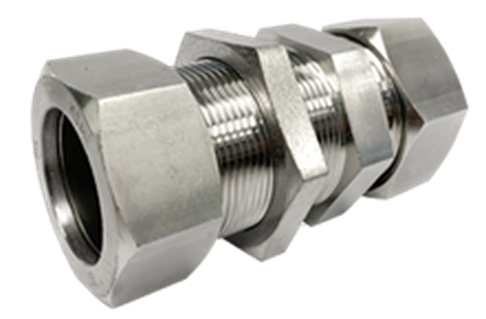
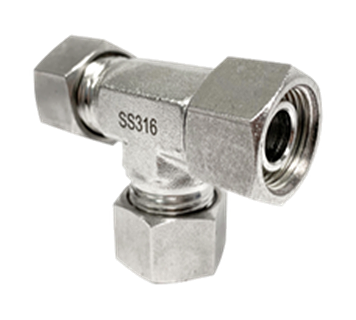

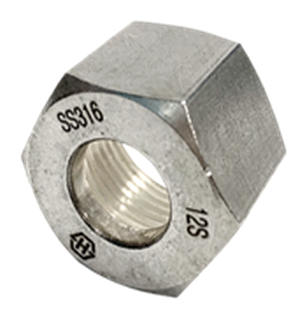
Flareless cutting-ring tube fittings in three series — LL to 100 bar, L to 500 bar, S to 800 bar — designed for commercial hydraulic oils. Right for field work, repairs, mixed sizes and joints that get broken for service.
State the tube OD & wall, working pressure, fluid, port thread form and sealing method — quotes back within 2 working hours.
| Standard | DIN 2353 · ISO 8434-1 |
|---|---|
| Series | LL (4–12 mm) · L (6–42 mm) · S (6–38 mm) |
| Materials | Stainless SS316 · zinc-plated carbon steel · brass |
| Threads | BSPP · metric · NPT · UN/UNF |
| Body styles | Unions · male/female connectors · adapters · banjos · plugs & caps |
| Set | Body + union nut + cutting ring — a new ring every assembly |
Full dimension tables per body style are in the catalogues below, as printed — the nut thread and pressure tables per series are on this page.
| At a glance | LL | L | S |
|---|---|---|---|
| Range | 4–12 mm | 6–42 mm | 6–38 mm |
| Series top | 100 bar | 500 bar | 800 bar |
| Union (PN) | 100 | 315 / 160 | 630 / 400 / 315 |
Hydraulic oil systems — the range is designed for commercial hydraulic oils; field work and repairs; mixed sizes in small numbers; and joints that get broken for service. Joint quality depends on how far the nut is turned — technique decides.
High-volume assembly → the Walform machine. Instrumentation and gas → twin-ferrule fittings. Pressures above the S-series ceiling or thin-walled tube → ask first.
Union nut thread per tube size M × pitch
| Tube OD | LL nut | L nut | S nut |
|---|---|---|---|
| 4 mm | M8×1.0 | — | — |
| 6 mm | M10×1.0 | M12×1.5 | M14×1.5 |
| 8 mm | M12×1.0 | M14×1.5 | M16×1.5 |
| 10 mm | M14×1.0 | M16×1.5 | M18×1.5 |
| 12 mm | M16×1.0 | M18×1.5 | M20×1.5 |
| 14 mm | — | — | M22×1.5 |
| 15 mm | — | M22×1.5 | — |
| 16 mm | — | — | M24×1.5 |
| 18 mm | — | M26×1.5 | — |
| 20 mm | — | — | M30×2.0 |
| 22 mm | — | M30×2.0 | — |
| 25 mm | — | — | M36×2.0 |
| 28 mm | — | M36×2.0 | — |
| 30 mm | — | — | M42×2.0 |
| 35 mm | — | M45×2.0 | — |
| 38 mm | — | — | M52×2.0 |
| 42 mm | — | M52×2.0 | — |
Working pressure by size bar · straight unions
| Series | Sizes | Working pressure |
|---|---|---|
| LL | 4 – 12 mm | 100 bar |
| L | 6 – 18 mm | 315 bar |
| L | 22 – 42 mm | 160 bar |
| S | 6 – 14 mm | 630 bar |
| S | 16 – 30 mm | 400 bar |
| S | 38 mm | 315 bar |
Materials and temperature limits
| Material | Temperature range | Pressure reduction |
|---|---|---|
| Stainless (DIN 17440) | −60 … +400 °C | Stepped: 4% (+50°) … 33% (+400°) |
| Steel (DIN 3859) | −40 … +120 °C | None |
| Brass | −60 … +175 °C | Flat 35% |
Cut the tube square, deburr inside and out. Check the wall matches the series, the ring faces the right way — and use a new ring every time.
Insert the tube to the abutment in the body and hold it; tighten the nut to the turn count for the size/series (1¼ turns from finger tight).
Back the nut off and look: a collar of material must stand ahead of the ring, all the way round. For volume work, use the pre-assembly tool.
Nut down until the torque rises, then the final part-turn (¼). Hold the body, turn the nut — rotating the body destroys the bite.
Body styles available: straight unions · male connectors (BSPP parallel, metric parallel/tapered, unified) · female connectors (BSPP, metric, NPT, DKI ring) · male-female adapters · banjos · plugs & caps · union nuts (EN) and cutting rings (ES) as separate line items.


Dimensions and part numbers are in the catalogues, as printed; stock and price are not — send the list and we confirm both.
No — not as a union. Straight union ratings: PN 630 (6–14 mm), PN 400 (16–30 mm), PN 315 (38 mm). The headline is the top of the whole range, not the rating of the fitting in your hand.
Wall thickness and pressure — and different nut threads at the same tube size prevent accidental mismatches between series.
No. The 6 mm nut is M10×1.0 (LL), M12×1.5 (L), M14×1.5 (S) — three incompatible parts.
Stainless: 0% to +20 °C, then stepped 4–33% to +400 °C. Brass: a flat 35%. Steel: no reduction (ceiling +120 °C).
Treat it as no. The ring work-hardens after its first bite; the same ring can return to the same tube position a limited number of times only. New tube = new ring.
Back the nut off after pre-assembly and look at the tube: a visible collar of material must stand ahead of the ring, right the way round.
For a handful of joints, no. For volume, yes — it forms the collar consistently and saves the fitting body.
Turning the body drags the cone round against the ring, spinning the ring on the tube and wiping out the bite.
Steel for ordinary duty (+120 °C max, no derating). Stainless for corrosion/temperature (+400 °C, with reduction). Brass for low pressure only (35% reduction).
Generally yes — the 24° cone and threads are standardised. For critical joints, keep ring and body from the same source.
Cold-drawn seamless hydraulic tube to a recognised standard — OD tolerance affects bite depth, the wall prevents collapse, hardness lets the ring bite. Hacksaw-cut tube only after proper squaring and deburring.
Yes — in our regional warehouses in Singapore and Malaysia, out within 24 hours of your PO; quotes within 2 working hours.
Related: double ferrule fittings · JIC fittings · Walform tube · hydraulic steel tubes · all high pressure fittings · baca halaman ini dalam Bahasa Indonesia