

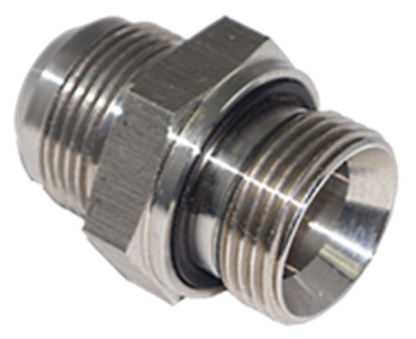
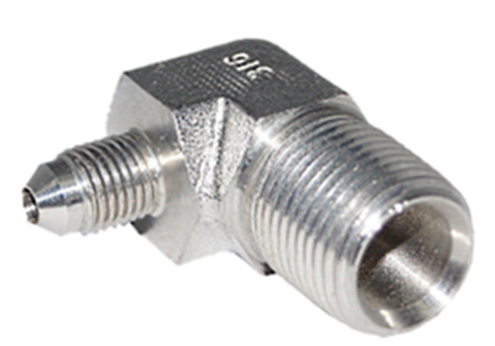
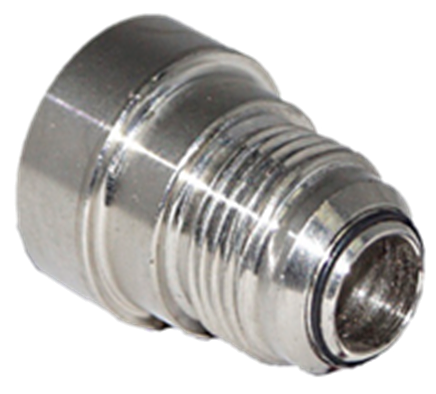
Three parts — body, sleeve and nut — sealing metal to metal on a 37° flared cone. No O-ring in the joint: which is why it survives temperatures an elastomer would not, and why it is the standard hose connection.
State the dash size (or tube OD), material and port thread combination — quotes back within 2 working hours.
| Standards | SAE J514 · ISO 8434-2 |
|---|---|
| Range | Stocked 1/4″–1 1/2″ (dash −04 to −24) · −02 to −32 to order |
| Pressure | To 430 bar — falls at larger sizes |
| Materials | SS316 (passivated) · carbon steel (white zinc) · brass |
| Temperature | −60…+200 °C (SS316 & steel) · −45…+175 °C (brass) |
| Port threads | JIC × JIC · JIC × BSPP · JIC × NPT |
Full dimensions per body style are in the catalogues below, as printed — the dash size and torque tables are on this page.
| At a glance | JIC 37° | NPT |
|---|---|---|
| Seal | 37° cone, metal-metal | Tapered thread + sealant |
| Vibration | Good | Poor |
| Reusability | Good | Poor |
Dash size and nominal thread UNF
| Dash | Tube OD | Nominal thread (UNF) |
|---|---|---|
| −02 | 1/8″ | 5/16 − 24 |
| −03 | 3/16″ | 3/8 − 24 |
| −04 | 1/4″ | 7/16 − 20 |
| −05 | 5/16″ | 1/2 − 20 |
| −06 | 3/8″ | 9/16 − 18 |
| −08 | 1/2″ | 3/4 − 16 |
| −10 | 5/8″ | 7/8 − 14 |
| −12 | 3/4″ | 1-1/16 − 12 |
| −14 | 7/8″ | 1-3/16 − 12 |
| −16 | 1″ | 1-5/16 − 12 |
| −20 | 1 1/4″ | 1-5/8 − 12 |
| −24 | 1 1/2″ | 1-7/8 − 12 |
| −32 | 2″ | 2-1/2 − 12 |
Assembly torque and over-torque limits Nm
| OD (metric) | OD (inch) | Assembly torque | Over-torque limit |
|---|---|---|---|
| 6 mm | 1/4″ | 15–16 | 24 |
| 8 mm | 5/16″ | 19–21 | 31 |
| 10 mm | 3/8″ | 24–28 | 42 |
| 12 mm | 1/2″ | 49–53 | 80 |
| 16 mm | 5/8″ | 77–85 | 114 |
| 20 mm | 3/4″ | 107–119 | 160 |
| 25 mm | 1″ | 147–154 | 214 |
| 32 mm | 1 1/4″ | 172–181 | 271 |
| 38 mm | 1 1/2″ | 215–226 | 339 |
| 50 mm | 2″ | 332–350 | 497 |
Over-torque deforms the 37° flare on the male end — excessive deformation loses clamping force, and with it the seal. The limit figure is a limit, not a target. Port seal limits (where an O-ring is fitted): NBR −23…+120 °C · FKM/Viton −20…+180 °C.
Inspect the surfaces, flare the tube to 37°.
Threads and flare face with hydraulic fluid.
Nut and sleeve; hand tighten until the sealing faces contact.
To the specification for the size — the table above. Never past the over-torque limit.
When JIC is right: hose connections (female swivel end) · high temperature (no elastomer to cook) · vibration-prone systems · mixed-thread systems (JIC to BSPP/NPT on one body). Alternatives: 24° ports → DIN 2353 · instrumentation/gas → twin-ferrule · NB pipe → forged fittings · frequent disconnects → QRCs.


Dimensions and part numbers are in the catalogues, as printed; stock and price are not — send the list and we confirm both.
Joint Industry Council — the body that originally standardised the design. The fittings conform to SAE J514 and ISO 8434-2.
The dash number is the numerator of a fraction over 16. A −08 is 8/16″, so 1/2″ tube.
Where the seal happens. JIC seals on a 37° cone — metal against metal, no sealant. NPT seals on the tapered thread itself: it needs sealant, and degrades when taken apart.
No — and this is the most expensive mistake on the range. JIC is 37°. Some port ends use a 60° cone with a soft seal — they look similar and will not seal against each other.
Yes — the nut and body are universal across both systems; only the sleeve changes.
To the assembly torque for the size (table above) — the over-torque figure is a limit, not a target.
Four causes: over-tightened (the flare is deformed and has lost clamping force) · wrong cone angle · damaged or dirty seat · external load.
Yes — it is the standard hose connection. The JIC body without its sleeve and nut is used as a hose adapter.
−60…+200 °C in SS316 and carbon steel; −45…+175 °C in brass. O-ring port ends are capped by the seal: NBR +120 °C, FKM +180 °C.
SS316 for corrosive, marine, washdown or high-temperature duty. White-zinc carbon steel for ordinary hydraulic work at lower cost.
Yes — 1/4″–1 1/2″ (dash −04 to −24) in our regional warehouses in Singapore and Malaysia, out within 24 hours; the full −02 to −32 range to order. Quotes within 2 working hours.
Related: DIN 2353 fittings · double ferrule fittings · quick release couplings · all high pressure fittings · baca halaman ini dalam Bahasa Indonesia