
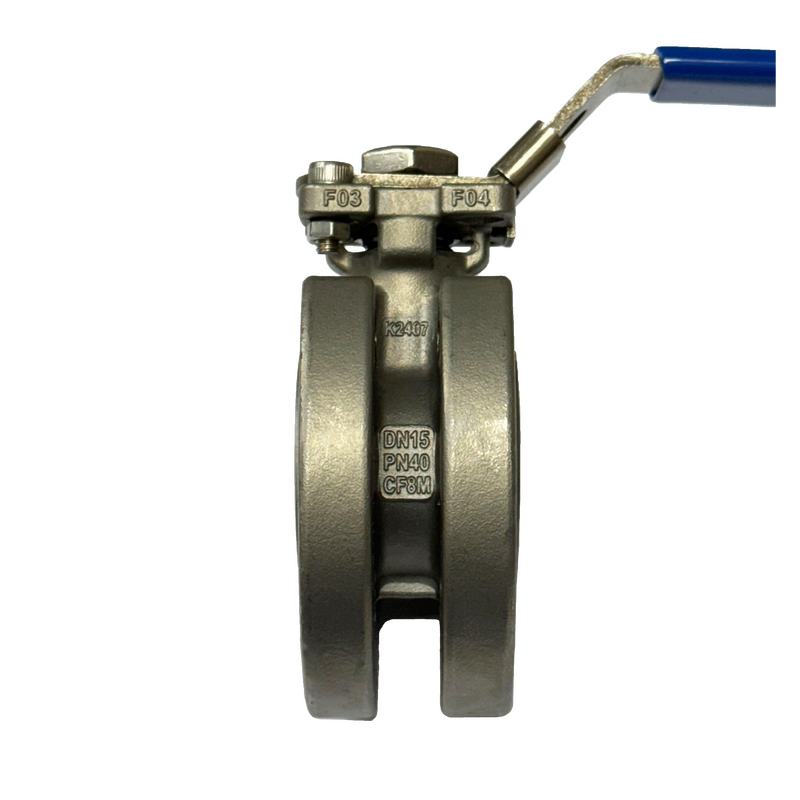
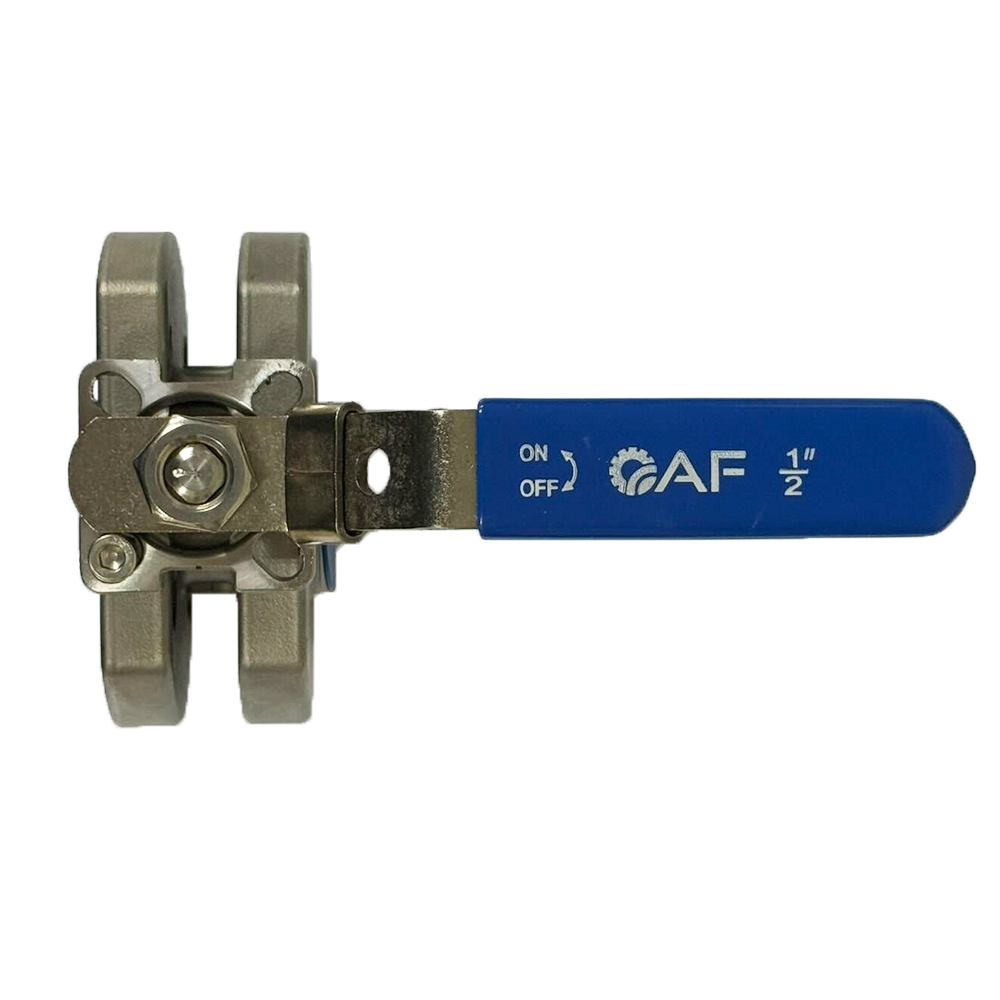
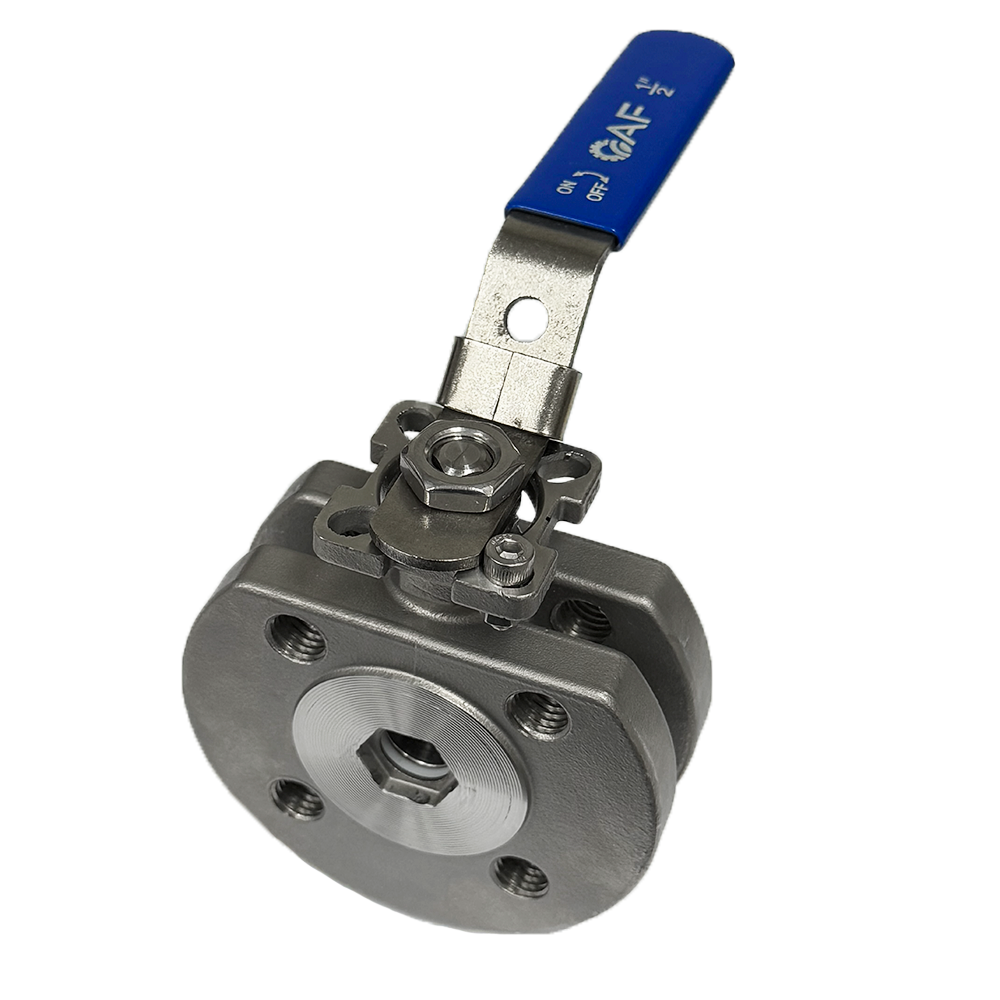
An SS316 wafer type ball valve clamped between two of your own pipe flanges rather than carrying flanges of its own. 1/2″ to 4″ (DN15–DN100), CF8M body, SS316 ball, PTFE seat, FKM O-ring. Face-to-face just 42 to 152 mm, and the only one in the range with an ISO 5211 F03/F04 actuator pad.
State the size, your flange class (PN16 or PN40) and the gap you have — quotes within 2 working hours.
| Body style | Wafer — clamped between two pipe flanges |
|---|---|
| Range | 1/2″ to 4″ (DN15–DN100), nine sizes |
| Flange standard | PN16 / PN40 — published dimensions follow PN16 |
| Body and cap | CF8M — cast 316 stainless |
| Ball / stem | SS316 / forged F316 |
| Seals | PTFE seat, gasket, thrust washer and packing; FKM O-ring |
| Actuator | ISO 5211, F03 and F04 |
| Face-to-face | 42 to 152 mm, L ±2 mm |
The nine-size dimension table with part numbers, the 10-item bill of materials and the PN16/PN40 fit table are all on this page, as printed in the catalogue.
A valve that borrows your flanges rather than carrying its own.
A flange end ball valve carries two flanges of its own, and that is what makes it long: at 4″ it needs roughly 394 mm of pipe. A wafer valve removes both of those flanges. Its body is clamped between your pipe flanges and held by long bolts that pass through both — so at 4″ it needs 152 mm, less than half.
The internals are the same as the flanged variants: an SS316 ball on a PTFE seat, inside a cast CF8M body. What differs is how it mounts — and one consequence to check first: it cannot terminate a run, because it needs a flange on both sides.
A wafer body needs a flange on both sides to clamp and seal it. If the valve has to be the end point, use a flange end variant.
ISO 5211 F03 and F04 pads are cast into the top plate. No other flange end variant in this range publishes an actuator pad — we confirm the pad size for your valve size before you order the actuator.
FKM suits oils and fuels, and is weaker than EPDM on hot water and steam. Every other sealing part — joint gasket, seat, thrust washer and packing — is PTFE.
From 1/2″ to 2″ PN16 and PN40 are identical. At 2½″ the bolt circle matches but PN40 uses 8 bolts where the table prints 4 — check that before ordering. The fit table is below.
Body and cap in CF8M (cast 316 stainless), ball in SS316, stem in forged F316 — forged is stronger than cast on the part that turns under load.
The catalogue for this valve does not print a working temperature, test pressures, weights or torque figures. We do not copy them across from another variant — send us the duty and we will obtain them from the factory.
All photographs of the stocked item, not renders.
The whole valve is barely thicker than a pair of flanges. That is the reason to choose it — and the reason it needs your flanges to hold it.
F03 and F04 pads are cast directly into the top plate, so an actuator mounts without an adaptor bracket.
The face that presses against your flange gasket. Diameter D3 in the size table — match your gasket to that, not just to the bore.
Everything that goes on a purchase order — including what is not published.
| Item | Detail |
|---|---|
| Size range | 1/2″ to 4″ (DN15 to DN100) — nine sizes |
| Body style | Wafer — clamped between two pipe flanges. It cannot terminate a run |
| Flange standard | PN16 / PN40 — the published dimensions follow PN16; check 2½″ and 4″ |
| Body and cap | CF8M — cast 316 stainless |
| Ball | SS316 |
| Stem | F316 forged stainless |
| Seat | PTFE |
| Gland | SS316 |
| O-ring | FKM — suits oils and fuels, weaker than EPDM on hot water and steam |
| Gasket, thrust washer, packing | PTFE throughout |
| Operation | Quarter turn lever, marked ON / OFF |
| Actuator mounting | ISO 5211, F03 and F04 cast into the top plate — what we confirm before you order |
| Face-to-face | 42 to 152 mm, published as L ±2 mm |
| Parts in the list | 10 |
| Not published | No working temperature, no test pressures, no weights, no torque figures — we obtain these from the factory on request |
| Fit upstream | A Y-strainer — grit is what scores a PTFE seat |
| Stock | Singapore and Malaysia warehouses — out within 24 hours |
Nine sizes, dimensions in millimetres. D2 the bolt circle and Z-M the hole pattern have to match your flange; L face-to-face is the gap it needs, published with a ±2 mm tolerance.
| Size | Part no | DN | Flange OD D1 | Bolt circle D2 | Seal face D3 | Face-to-face L ±2 | Flange thk F | Raised face f1 | Bolts Z-M |
|---|---|---|---|---|---|---|---|---|---|
| 1/2″ | VL-B-S-T-F-08 | 15 | 95 | 65 | 45 | 42 | 16 | 2 | 4-12 |
| 3/4″ | VL-B-S-T-F-12 | 20 | 105 | 75 | 58 | 45 | 18 | 2 | 4-12 |
| 1″ | VL-B-S-T-F-16 | 25 | 115 | 85 | 68 | 51 | 18 | 2 | 4-12 |
| 1¼″ | VL-B-S-T-F-20 | 32 | 140 | 100 | 78 | 59 | 18 | 2 | 4-16 |
| 1½″ | VL-B-S-T-F-24 | 40 | 150 | 110 | 88 | 64 | 18 | 2 | 4-16 |
| 2″ | VL-B-S-T-F-32 | 50 | 165 | 125 | 102 | 79 | 20 | 2 | 4-16 |
| 2½″ | VL-B-S-T-F-40 | 65 | 185 | 145 | 122 | 112 | 18 | 3 | 4-16 |
| 3″ | VL-B-S-T-F-48 | 80 | 200 | 160 | 138 | 121 | 20 | 3 | 8-16 |
| 4″ | VL-B-S-T-F-64 | 100 | 220 | 180 | 158 | 152 | 20 | 3 | 8-16 |
This table prints no weight column and no overall height. For support or shipping calculations, ask us and we will measure a stocked unit.
79 mm at 2″ then 112 mm at 2½″. Measure the gap in your run — the tolerance is ±2 mm, so do not design it tight.
It is 20 mm at 2″, drops to 18 mm at 2½″, then 20 mm again at 3″ and 4″ — as printed.
2 mm to 2″, then 3 mm at 2½″, 3″ and 4″. Match your gasket to that figure.
At 4″ this valve needs 152 mm; the ANSI 150 SS316 needs 229 mm and the 6″ cast steel variant needs 394 mm.
The published dimensions follow PN16. At most sizes PN16 and PN40 are identical, but not all — and what differs is the bolt count, not the circle.
| Size | Published D1 / D2 / bolts | PN16 | PN40 | Does the table fit PN40? |
|---|---|---|---|---|
| 1/2″ to 2″ | as published | same | same | Yes — the two standards are identical here |
| 2½″ (DN65) | 185 / 145, 4 bolts | 185 / 145, 4 | 185 / 145, 8 | ⚠ Bolt count only. The circle matches; the hole count does not |
| 3″ (DN80) | 200 / 160, 8 bolts | 200 / 160, 8 | 200 / 160, 8 | Yes |
⚠ At 2½″ (DN65), check the bolt count. The 185/145 mm bolt circle matches on both classes, but a PN40 flange uses eight bolts where the valve table prints four. If your pipework is PN40 at that size, tell us and we will confirm the drilling on the stocked unit before it ships.
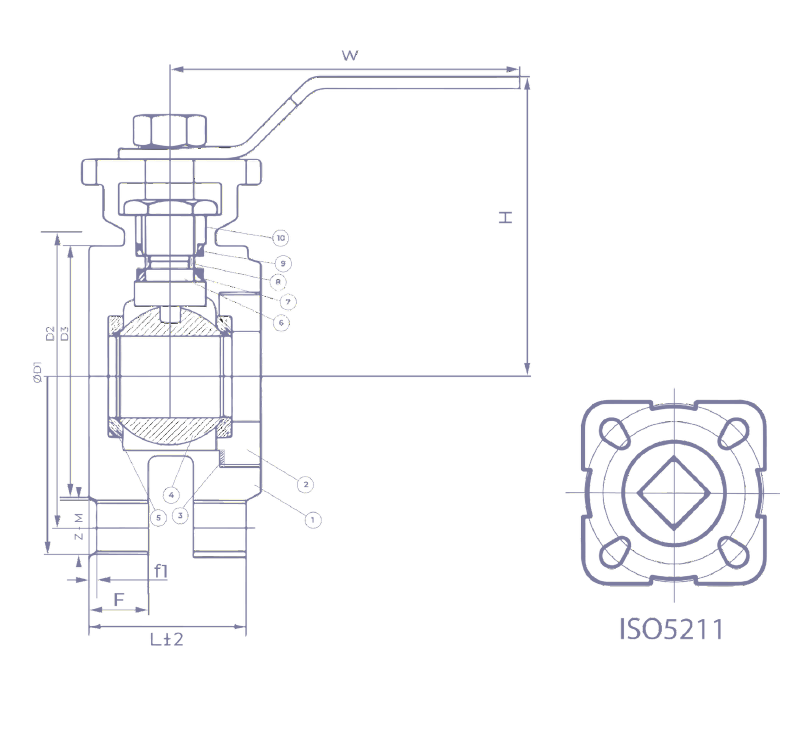
Numbered to match the parts list below. The section shows the thin wafer body, the ball and its PTFE seats, the packing stack around the stem, and the top plate the ISO 5211 pads are cast into.
| No | Part name | Material |
|---|---|---|
| 1 | Body | CF8M |
| 2 | Cap | CF8M |
| 3 | Joint Gasket | PTFE |
| 4 | Ball | SS316 |
| 5 | Seat | PTFE |
| 6 | Stem | F316 |
| 7 | Thrust Washer | PTFE |
| 8 | O-ring | FKM |
| 9 | Packing | PTFE |
| 10 | Gland | SS316 |
The SS316 flange end variants list 14 to 17. Fewer parts in a far thinner body — which is why it fits.
Body and cap in CF8M (cast 316), ball in SS316, stem in forged F316; joint gasket, seat, thrust washer and packing in PTFE.
And it is what narrows the fluid range. FKM is good on oils and fuels; it is not the first choice for hot water or steam. Tell us the fluid and we will confirm.
F316 forged on the stem, CF8M cast on the body — forged is stronger on the part that turns under torque.
A wafer valve is chosen on space first, then on the actuator.
All seven, side by side: the comparison table.
The manufacturer's catalogue for this wafer range is not yet published as a direct download on this site — unlike the six flange end variants. Ask for it through contact or WhatsApp and we will send the PDF straight over, along with any dimension or figure this page does not print.
A valve that carries no flanges of its own. The body is clamped between two of your pipe flanges and held by bolts that pass through both. That makes it far shorter than a flange end valve — 152 mm at 4″ against roughly 394 mm — and it is the reason to choose one when the gap in the pipe run is tight.
No. A wafer body needs a flange on both sides to clamp and seal it — it cannot terminate a run. If the valve has to be the end point, use a flange end variant that carries its own flanges.
The published dimensions follow PN16. From 1/2″ to 2″ the two standards are identical, so it fits both. At 2½″ the bolt circle matches but PN40 uses 8 bolts where the table prints 4 — check that before ordering. At 3″ both match.
Yes — ISO 5211 F03 and F04 pads are cast into the top plate. This is the only valve in the flange end range with a published actuator pad. We confirm the pad size for your valve size before you order the actuator.
FKM suits oils and fuels, and is weaker than EPDM on hot water and steam. Every other sealing part — joint gasket, seat, thrust washer and packing — is PTFE. Tell us the fluid and we will confirm whether FKM is appropriate.
The catalogue for this valve publishes no working temperature, no test pressures, no weights and no torque figures. Its nominal rating is PN16/PN40 from the flange standard. We do not copy figures across from another variant — send us the duty and we will obtain them from the factory.
Considerably. Face-to-face runs 42 mm at 1/2″ to 152 mm at 4″, ±2 mm. A flange end ball valve at 4″ needs roughly 394 mm. That is the whole reason to choose a wafer body.
A Y-strainer. Grit is what scores a PTFE seat, and on a valve this small a scored seat means the valve is replaced, not repaired.
Held in our Singapore and Malaysia warehouses, out within 24 hours of your PO; quotes within 2 working hours.
Related: all flange end ball valves · PN10/16 SS316 if you need a flanged body · Y-strainers to fit upstream · flanges.