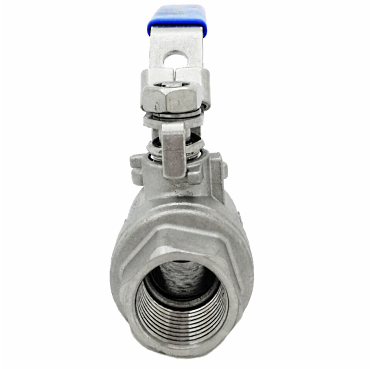
The most commonly used ball valve construction: full bore, so the ball hole matches the pipe diameter, and it comes apart to replace the internals — off the line. It is also the only variant in the whole ball valve range that reaches 2,000 PSI.
State size, the 1,000 or 2,000 PSI range, and BSPP or NPT — quotes within 2 working hours.
| Construction | Two-piece — serviceable trim (off-line) |
|---|---|
| Bore | Full bore — matches the pipe diameter |
| 1,000 PSI range | 1/4″ to 4″ (11 sizes) |
| 2,000 PSI range | 1/4″ to 3″ (10 sizes, separate range) |
| Temperature | −29…150 °C — set by the PTFE seat |
| Body | SS316 with CF8M castings |
| Ends | Threaded BSPP or NPT |
| Operation | Quarter turn, manual lever |
Both full dimension tables with part numbers, the 13-item bill of materials and the derating curve are on this page, as printed in the catalogue.
The most commonly used construction — and the reasons are all trade-offs.
The two-piece is the most commonly used construction type of ball valve, and it is the default choice in this range. It has two separate pieces: the first carries the body and one end connection, and the second fits into the first to hold the trim in place and provides the second end connection. The two are joined by a thread or by bolts.
Splitting the body buys two things the one-piece cannot offer. It is full bore — the ball is over-sized so the hole through it matches the pipeline, and the valve does not restrict the line. And it allows disassembly of the valve if the internal parts need replacing. The cost is equally clear: valves designed this way hold the potential of leakage where the two pieces are joined. A joint you can open is a joint that can weep.
The two-piece is the standard bore — at 1/2″ the bore is 15 mm, matching DN15 pipe, against 9 mm on the one-piece.
It is supplied in two separate ranges — 1000 PSI and 2000 PSI — with different dimensions and different part numbers. “2 piece ball valve” on its own does not specify which.
The body joint is the price of serviceability. It is a designed, gasketed joint and it does not normally leak — but if you want no body joint at all, that is the one-piece.
You can strip it and re-seat it — off the pipe. To do that without a line shutdown, you want the three-piece.
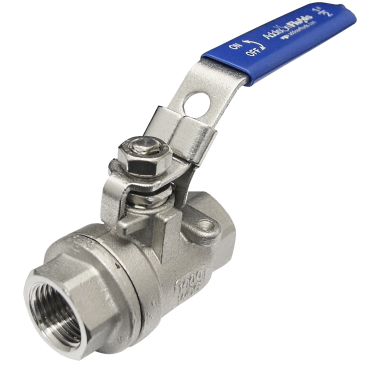
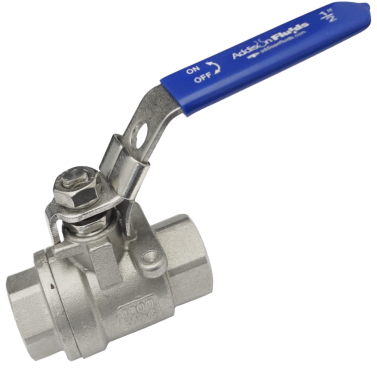
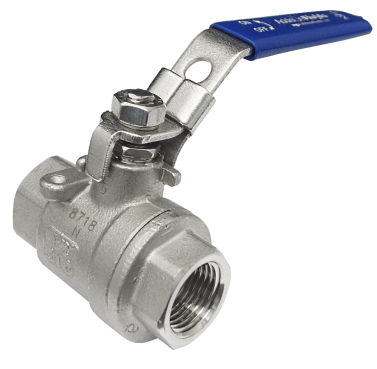
All photographs of the stocked item, not renders.
The body joint is visible. The smaller piece screws into the main body and holds the trim in place — that joint is what lets you open the valve, and the one extra place it could weep.
The hole matches the pipe. The ball is over-sized so the bore through it equals the line size — the valve is not a restriction when it is open.
Both pieces take a spanner. Which is how the valve comes apart for re-seating — and why it must be done off the line rather than in it.
The stem assembly. Stem nut, spring washer and packing gland stacked on the stem — items 10 to 13 on the parts list, and the only part of the valve adjustable in service.
Two pressure ranges. Read the row that applies to yours.
| Item | Detail |
|---|---|
| Size range | 1/4″ to 4″ (DN8–DN100) at 1000 PSI · 1/4″ to 3″ (DN8–DN80) at 2000 PSI |
| Body construction | Two piece — body plus a second piece that holds the trim. Serviceable off the line |
| Bore | Full bore — the standard bore; the ball hole matches the pipeline |
| Body material | Stainless steel SS316, with CF8M where the part is cast |
| Working pressure | 1000 PSI or 2000 PSI — two distinct ranges, different dimensions and part numbers |
| Working temperature | −29 °C to 150 °C — pressure derates with temperature |
| Connection type | Threaded BSPP or NPT |
| Seat and seals | PTFE seat, seal gasket, stem seal and stem packing |
| Ball and stem | SS316, with an SS304 anti-static device |
| Operation | Quarter turn manual lever |
| IMPA codes | Published across the 2000 PSI range — 75 66 65–74 (BSPP) and 75 65 89–98 (NPT) |
| Stock | Singapore and Malaysia warehouses — out within 24 hours |
| Size | Bore | L (mm) | H (mm) | Handle E (mm) | Weight | Part no. BSPP | Part no. NPT |
|---|---|---|---|---|---|---|---|
| 1/4″ | 10 | 53 | 45 | 100 | 0.21 kg | VL-S-B2-G-1000-04 | VL-S-B2-N-1000-04 |
| 3/8″ | 12 | 53 | 45 | 100 | 0.25 kg | VL-S-B2-G-1000-06 | VL-S-B2-N-1000-06 |
| 1/2″ | 15 | 62 | 49 | 104 | 0.30 kg | VL-S-B2-G-1000-08 | VL-S-B2-N-1000-08 |
| 3/4″ | 20 | 70 | 55 | 118 | 0.51 kg | VL-S-B2-G-1000-12 | VL-S-B2-N-1000-12 |
| 1″ | 25 | 81 | 67 | 145 | 0.75 kg | VL-S-B2-G-1000-16 | VL-S-B2-N-1000-16 |
| 1¼″ | 32 | 95 | 70 | 145 | 1.48 kg | VL-S-B2-G-1000-20 | VL-S-B2-N-1000-20 |
| 1½″ | 38 | 105 | 80 | 177 | 1.72 kg | VL-S-B2-G-1000-24 | VL-S-B2-N-1000-24 |
| 2″ | 50 | 117 | 92 | 177 | 3.08 kg | VL-S-B2-G-1000-32 | VL-S-B2-N-1000-32 |
| 2½″ | 65 | 163 | 113 | 224 | 4.85 kg | VL-S-B2-G-1000-40 | VL-S-B2-N-1000-40 |
| 3″ | 80 | 190 | 127 | 242 | 7.53 kg | VL-S-B2-G-1000-48 | VL-S-B2-N-1000-48 |
| 4″ | 96 | 227 | 180 | 280 | 13.5 kg | VL-S-B2-G-1000-64 | VL-S-B2-N-1000-64 |
Compare the bore column with the 1-piece page: at 1/2″ this is 15 mm against 9 mm; at 2″ it is 50 mm against 32 mm. That is what full bore means. The cost is weight and length: at 4″ this valve is 13.5 kg against 9.05 kg for the 1-piece.
1/2″ is 15 mm, 1″ is 25 mm, 2″ is 50 mm — each equal to the nominal DN. The one-piece at the same sizes is 9, 15 and 32 mm.
Across the whole 1000 PSI range — verified row by row. Only the part number changes.
A mismatched pair engages and feels tight, then leaks later. Send a photo if you are unsure what is on the pipework.
At 4″ it is 280 mm, and it needs a clear 90° sweep.
| Size | Connection | IMPA | Part no. | Bore | L (mm) | H (mm) | Handle E | Weight |
|---|---|---|---|---|---|---|---|---|
| 1/4″ | BSPP | 75 66 65 | VL-S-B2-G-2000-04 | 10 | 6* | 42 | 95 | 0.21 kg |
| 3/8″ | BSPP | 75 66 66 | VL-S-B2-G-2000-06 | 12 | 55 | 42 | 95 | 0.25 kg |
| 1/2″ | BSPP | 75 66 67 | VL-S-B2-G-2000-08 | 15 | 62 | 51 | 108 | 0.30 kg |
| 3/4″ | BSPP | 75 66 68 | VL-S-B2-G-2000-12 | 20 | 72 | 58 | 115 | 0.51 kg |
| 1″ | BSPP | 75 66 69 | VL-S-B2-G-2000-16 | 25 | 84 | 77 | 135 | 0.75 kg |
| 1¼″ | BSPP | 75 66 70 | VL-S-B2-G-2000-20 | 32 | 97 | 83 | 150 | 1.48 kg |
| 1½″ | BSPP | 75 66 71 | VL-S-B2-G-2000-24 | 38 | 104 | 97 | 175 | 1.72 kg |
| 2″ | BSPP | 75 66 72 | VL-S-B2-G-2000-32 | 50 | 120 | 106 | 190 | 3.08 kg |
| 2½″ | BSPP | 75 66 73 | VL-S-B2-G-2000-40 | 65 | 150 | 122 | 220 | 4.85 kg |
| 3″ | BSPP | 75 66 74 | VL-S-B2-G-2000-48 | 80 | 164 | 140 | 250 | 7.53 kg |
| 1/4″ | NPT | 75 65 89 | VL-S-B2-N-2000-04 | 10 | 55 | 42 | 95 | 0.21 kg |
| 3/8″ | NPT | 75 65 90 | VL-S-B2-N-2000-06 | 10 | 55 | 42 | 95 | 0.25 kg |
| 1/2″ | NPT | 75 65 91 | VL-S-B2-N-2000-08 | 15 | 62 | 51 | 108 | 0.30 kg |
| 3/4″ | NPT | 75 65 92 | VL-S-B2-N-2000-12 | 20 | 72 | 58 | 115 | 0.51 kg |
| 1″ | NPT | 75 65 93 | VL-S-B2-N-2000-16 | 25 | 84 | 77 | 135 | 0.75 kg |
| 1¼″ | NPT | 75 65 94 | VL-S-B2-N-2000-20 | 32 | 97 | 83 | 150 | 1.48 kg |
| 1½″ | NPT | 75 65 95 | VL-S-B2-N-2000-24 | 38 | 104 | 97 | 175 | 1.72 kg |
| 2″ | NPT | 75 65 96 | VL-S-B2-N-2000-32 | 49 | 120 | 106 | 190 | 3.08 kg |
| 2½″ | NPT | 75 65 97 | VL-S-B2-N-2000-40 | 63 | 150 | 122 | 220 | 4.85 kg |
| 3″ | NPT | 75 65 98 | VL-S-B2-N-2000-48 | 80 | 164 | 140 | 250 | 7.53 kg |
Three bore figures differ between BSPP and NPT in the 2,000 PSI range, as printed: 3/8″ 12 against 10 mm · 2″ 50 against 49 mm · 2½″ 65 against 63 mm. *And the 1/4″ BSPP length is published as 6 mm where the NPT is 55 mm — we print it as printed and confirm the figure with the factory when you ask.
The 1000 PSI range runs to 4″; the 2000 PSI range stops at 3″ (DN80). If you need 4″ and 2000 PSI, this is not the valve — talk to us about high pressure ball valves.
Where the 1/4″ NPT row shows 55 mm at the same weight — quoted as printed. Ask us to confirm the length before you cut pipe to it and we measure a stocked unit.
3/8″ is 12 mm BSPP against 10 mm NPT; 2″ is 50 against 49; 2½″ is 65 against 63. Small, but if you are sizing on flow rather than on thread, order against the row for the thread form you are actually buying.
75 66 65 to 75 66 74 for BSPP and 75 65 89 to 75 65 98 for NPT — the most completely coded range on this page, which makes it the easiest to order for marine work.
The same derating applies: about 67% of it at 150 °C.
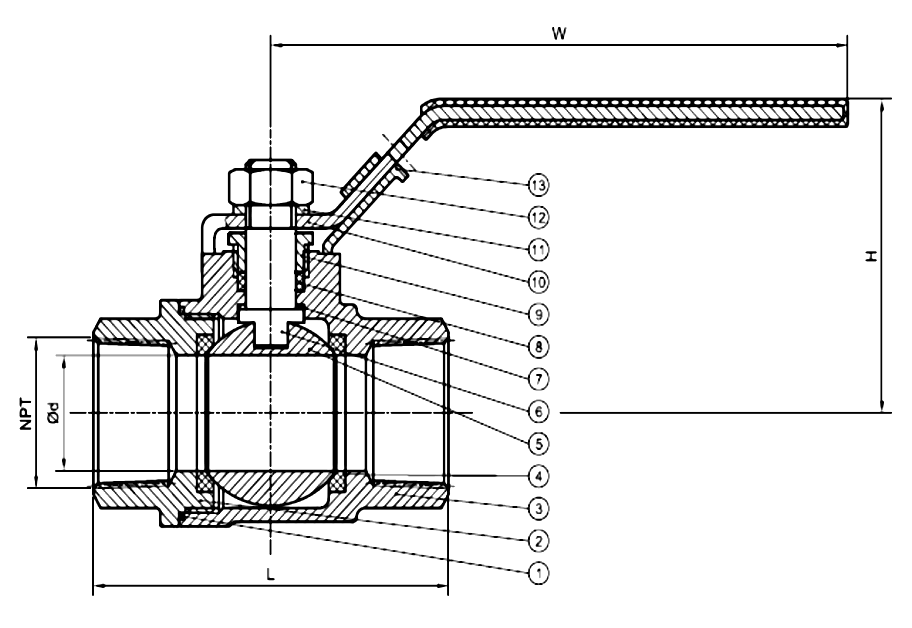
Numbered to match the parts list below. The section shows the two-piece body with the joint between them, the full bore Ød through the ball matching the thread, and the dimensions L face-to-face, H height and W handle span.
| No. | Part name | Material |
|---|---|---|
| 1 | Body | SS316 & CF8M |
| 2 | Cap | SS316 |
| 3 | Seat | PTFE |
| 4 | Ball | SS316 |
| 5 | Seal gasket | PTFE |
| 6 | Stem seal | PTFE |
| 7 | Stem | SS316 |
| 8 | Anti-static device | SS304 |
| 9 | Stem packing | PTFE |
| 10 | Packing gland | SS304 |
| 11 | Spring washer | SS301 |
| 12 | Handle | SS201 |
| 13 | Stem nut | SS304 |
Body, cap, ball and stem in SS316; seat, seal gasket, stem seal and stem packing in PTFE.
On a two-piece this part matters more than it does on a one-piece, because it is what closes the joint between the two body halves — and it is PTFE, the same material as the seat.
Same SS316 ball, same PTFE seats, same anti-static device. Construction is not a quality grade — it is a different answer to a different question.
A ball turning on PTFE seats is electrically isolated; the SS304 device gives the charge a path out. Standard on this valve, and it matters on hydrocarbon duty.
Hence 150 °C, and hence the derating.
| Temperature | Pressure (bar) | Pressure (PSI) | % cold rating |
|---|---|---|---|
| −30…+20 °C | 63 | 914 | 100% |
| 40 °C | 59.8 | 867 | 95% |
| 60 °C | 56.5 | 819 | 90% |
| 80 °C | 53.3 | 773 | 85% |
| 100 °C | 50.1 | 727 | 80% |
| 120 °C | 46.8 | 679 | 74% |
| 140 °C | 43.6 | 632 | 69% |
| 150 °C | 42 | 609 | 67% |
The 150 °C ceiling is set by the PTFE seat, not the SS316 body — and it applies to both pressure ranges. State pressure and temperature together when ordering.
63 bar cold, 42 bar hot — 67%. If you sized on the catalogue figure and the line runs warm, the margin you thought you had is not there.
The curve is flat from −30 °C, so ambient and chilled service get the full rating.
The curve drops vertically to zero there. Do not design a small margin beyond it.
1000 PSI and 2000 PSI alike — it is the PTFE seat that limits, and the seat is the same in both.
With the derating curve drawn to 63 bar. For duty near the limit, give us the pressure and temperature together and we confirm against the specific part number.
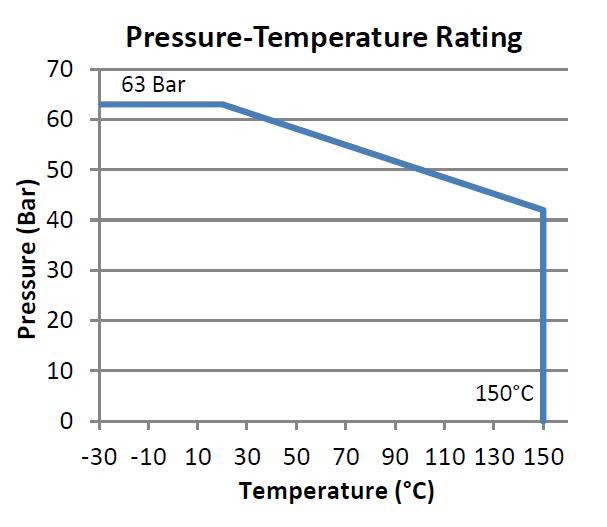
Flat, then falling, then a wall. 63 bar from −30 °C to about +20 °C, then a straight decline to 42 bar at 150 °C, where it drops vertically to zero.
This is the default. Here is when it is not.
All eight, side by side: the comparison table.
Dimensions and part numbers are in the catalogue, as printed; stock and price are not — send the list and we confirm both.
Two separate pieces: one carries the body and one end connection; the second fits into it to hold the trim and provide the other connection.
Yes. The ball is oversized so the hole matches the pipeline size — there is no flow restriction.
Yes, but it must come out of the line. Both body pieces have hex flats for disassembly and re-seating.
Not normally — the joint is designed with a PTFE gasket. But the construction does create one potential leak path where the pieces join, and that is the one thing a 1-piece does not have.
1,000 PSI or 2,000 PSI — two different valves with their own dimensions and part numbers, not one valve with two ratings. Both are cold ratings; expect about 67% of capacity at 150 °C.
Per the manufacturer's specification. Three bore figures vary: 3/8″ 12 against 10 mm · 2″ 50 against 49 mm · 2½″ 65 against 63 mm. The 1/4″ BSPP length is also published as 6 mm against 55 mm for NPT — we print it as printed and confirm the figure with the factory on enquiry.
Body, cap, ball and stem SS316 (CF8M where cast); seat, seals and packing PTFE; anti-static device and gland SS304; spring washer SS301; handle SS201.
Choose 2-piece for a standard full-bore application. Choose 3-piece only if the line cannot be shut down — the end caps stay in the pipe during maintenance — or if you need weld ends.
−29 to 150 °C, and the limit is set by the PTFE seat, not the SS316 body.
1/4″–4″ at 1,000 PSI and 1/4″–3″ at 2,000 PSI, both BSPP and NPT — held in our regional warehouses in Singapore and Malaysia, out within 24 hours of your PO.
Related: all ball valves · three-piece if the line cannot be stopped · class 150 threaded fittings for the pipework.