A three-piece ball valve: two end caps that stay connected to the pipe, and a centre body that lifts out. For lines that cannot be shut down while the internals are replaced — and for pipework that demands a welded joint, because this is the only variant that offers one.
State the size and the end type — BSPP, NPT, socket weld or butt weld — and we quote within 2 working hours.
| Construction | Three piece — serviceable in the line |
|---|---|
| Range | 1/4″–4″ threaded · 3/8″–4″ butt weld |
| Bore | Full bore — matches the pipe |
| Pressure | 1000 PSI cold — derate for temperature |
| Temperature | −29…150 °C |
| Body | SS316, CF8M where cast |
| Ends | BSPP · NPT · socket weld · butt weld |
| Body bolts | SS304 |
The 33-row threaded dimension table, the butt weld table with part numbers, the 14-item bill of materials and the derating curve are all on this page, as printed in the catalogue.
Two end caps and a body. The end caps never leave the pipe.
A three-piece low pressure ball valve comprises three pieces: two end caps and a body, held together by bolts. The end caps are threaded, welded or flanged to connect to the pipe on both sides. Valves with this construction are specifically designed to separate the connection portions of the valve assembly from the rest of the body.
That separation is the entire point, and it has one consequence worth paying for. Because the end caps stay attached to the pipework, the centre body section can be unbolted and lifted out while the pipe stays where it is. So the three-piece prevents a line shutdown if maintenance is required — you re-seat the valve without breaking the pipe run, draining a system or cutting a weld.
Threaded BSPP and NPT, plus socket weld and a separate butt weld range. Nothing else on this range is offered welded.
On a two-piece, welding the valve in means you can never take it out without cutting. On a three-piece the weld is on the end cap, and the centre still comes out. That combination is why the design exists.
Bore equals the nominal DN at every size — 15 mm at 1/2″, 25 mm at 1″, 50 mm at 2″. Compared to reduced bore.
Two body joints instead of one, which is the trade for the access. They are gasketed, designed joints — but if you want the fewest possible sealing surfaces, that is the one-piece.
The dimension tables publish a bolt pitch circle diameter, because the body is bolted — useful if you are checking clearance for a socket or a torque wrench.
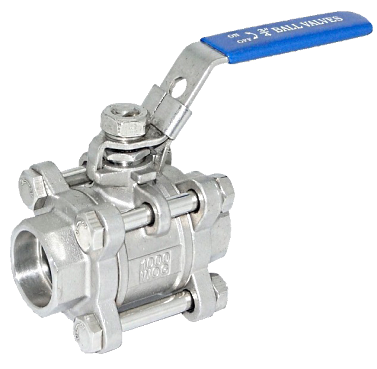
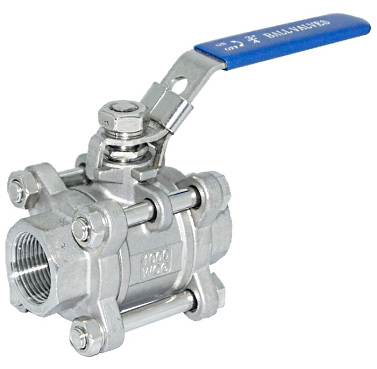
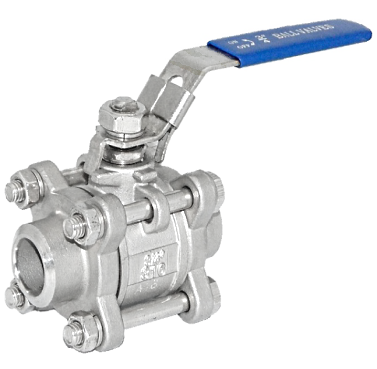
All photographs of the stocked item, not renders.
Two end caps, one centre body. The bolts are the whole design: undo them and the centre lifts out while both end caps stay connected to the pipe.
No restriction when open. The bore through the ball equals the pipe bore at every size — the same as the two-piece, and unlike the one-piece.
Four bolts and the trim is accessible. Which is how seat replacement happens without a line shutdown — the reason this construction costs more than a two-piece.
Everything that goes on a purchase order.
| Item | Detail |
|---|---|
| Size range | 1/4″ to 4″ (DN8 to DN100) threaded · 3/8″ to 4″ butt weld |
| Body construction | Three piece — two end caps and a bolted centre body. Serviceable in the line |
| Bore | Full bore — the ball hole matches the pipeline |
| Body material | Stainless steel SS316, with CF8M where the part is cast |
| Working pressure | 1000 PSI cold — derate for temperature |
| Working temperature | −29 °C to 150 °C |
| Connection types | Threaded BSPP · NPT · socket weld · butt weld — the only variant here offered welded |
| Seat and seals | PTFE seat, seal, stem seal and packing |
| Ball and stem | SS316, on SS304 body bolts |
| Operation | Quarter turn manual lever |
| Key benefit | Prevents a line shutdown when maintenance is required — the end caps stay in the pipe |
| Stock | Singapore and Malaysia warehouses — out within 24 hours |
33 rows as published, across BSPP, NPT and socket weld. Dimensions in millimetres. d is the bore through the ball, L face-to-face, H the height from the pipe centreline, E the handle length, and PCD the bolt pitch circle diameter. Rows are left grouped by connection type exactly as the manufacturer publishes them.
| Size | Connection | Bore d | Length L | Height H | Handle E | PCD | Weight (kg) |
|---|---|---|---|---|---|---|---|
| 1/4″ | BSPP | 10 | 66 | 45 | 100 | – | 0.30 |
| 3/8″ | BSPP | 12 | 66 | 45 | 100 | – | 0.30 |
| 1/2″ | BSPP | 15 | 73 | 53 | 104 | 33 | 0.51 |
| 3/4″ | BSPP | 20 | 79.5 | 58 | 118 | 39.5 | 0.73 |
| 1″ | BSPP | 25 | 86.5 | 68 | 145 | 43.5 | 0.91 |
| 1¼″ | BSPP | 32 | 108 | 81 | 162 | 55.5 | 1.56 |
| 1½″ | BSPP | 38 | 118 | 85 | 180 | 60 | 1.86 |
| 2″ | BSPP | 50 | 144 | 92 | 180 | 75 | 2.98 |
| 2½″ | BSPP | 65 | 180 | 115 | 242 | 94 | 6.65 |
| 3″ | BSPP | 80 | 209 | 130 | 242 | 100 | 10.07 |
| 4″ | BSPP | – | – | – | – | 123 | 17.79 |
| 1/4″ | NPT | 10 | 66 | 45 | 100 | – | 0.30 |
| 3/8″ | NPT | 12 | 66 | 45 | 100 | – | 0.30 |
| 1/2″ | NPT | 15 | 73 | 53 | 104 | 33 | 0.51 |
| 3/4″ | NPT | 20 | 79.5 | 58 | 118 | 39.5 | 0.73 |
| 1″ | NPT | 25 | 86.5 | 68 | 145 | 43.5 | 0.91 |
| 1¼″ | NPT | 32 | 108 | 81 | 162 | 55.5 | 1.56 |
| 1½″ | NPT | 38 | 118 | 85 | 180 | 60 | 1.86 |
| 2″ | NPT | 50 | 144 | 92 | 180 | 75 | 2.98 |
| 2½″ | NPT | 65 | 180 | 115 | 224 | 94 | 6.65 |
| 3″ | NPT | 80 | 209 | 130 | 242 | 100 | 10.07 |
| 4″ | NPT | – | – | – | – | 123 | 17.79 |
| 1/4″ | SW | 10 | 66 | 45 | 100 | – | 0.30 |
| 3/8″ | SW | 12 | 66 | 45 | 100 | – | 0.30 |
| 1/2″ | SW | 15 | 73 | 53 | 104 | 33 | 0.51 |
| 3/4″ | SW | 20 | 79.5 | 58 | 118 | 39.5 | 0.73 |
| 1″ | SW | 25 | 86.5 | 68 | 145 | 43.5 | 0.91 |
| 1¼″ | SW | 32 | 108 | 81 | 162 | 55.5 | 1.55 |
| 1½″ | SW | 38 | 118 | 85 | 180 | 60 | 1.85 |
| 2″ | SW | 50 | 144 | 92 | 180 | 75 | 2.98 |
| 2½″ | SW | 65 | 180 | 115 | 224 | 94 | 3.54 |
| 3″ | SW | 80 | 209 | 130 | 242 | 100 | 6.38 |
| 4″ | SW | – | – | – | – | 123 | – |
The dimensions are nearly identical across all three end types — with two printed exceptions. The 2½″ handle is 242 mm on BSPP but 224 mm on NPT and socket weld. And the socket weld weights are far lighter at the top: 3.54 kg against 6.65 kg at 2½″, 6.38 against 10.07 at 3″.
The butt weld table below carries its codes in full (VL-S-B3-); for the threaded valve, state the size and end type on your enquiry and we confirm the order code with the factory before anything ships.
At 2½″ the published weight is 6.65 kg threaded against 3.54 kg socket weld, and at 3″ it is 10.07 against 6.38. Those gaps are too large to be rounding — read the row for the end type you are actually buying.
242 mm on BSPP against 224 mm on NPT and socket weld. Check it if the valve is going somewhere tight.
That is what makes it full bore, and it is the practical difference from the one-piece.
10 sizes, 3/8″ to 4″, with part numbers we can stand behind. The butt weld range is published separately, and its part numbers are internally consistent — the VL-S-B3-BW- prefix correctly identifies a three-piece butt weld valve. W here is the weld end width rather than a handle dimension.
| Size | Part no | Bore d | Length L | Height H | Width W | PCD | Weight (kg) |
|---|---|---|---|---|---|---|---|
| 3/8″ | VL-S-B3-BW-1000-06 | 12.5 | 66 | 45 | – | – | – |
| 1/2″ | VL-S-B3-BW-1000-08 | 15 | 74 | 50 | 26 | 33 | 0.57 |
| 3/4″ | VL-S-B3-BW-1000-12 | 20 | 79 | 60 | 30.5 | 39.5 | 0.51 |
| 1″ | VL-S-B3-BW-1000-16 | 25 | 88 | 65 | 36 | 43.5 | 0.73 |
| 1¼″ | VL-S-B3-BW-1000-20 | 32 | 108 | 85 | 48 | 55.5 | 0.91 |
| 1½″ | VL-S-B3-BW-1000-24 | 38 | 119 | 85 | 54 | 60 | 1.56 |
| 2″ | VL-S-B3-BW-1000-32 | 49 | 143 | 95 | 68 | 75 | 1.86 |
| 2½″ | VL-S-B3-BW-1000-40 | 65 | 180 | 92 | 86 | 94 | – |
| 3″ | VL-S-B3-BW-1000-48 | 78 | 209 | 130 | 100 | 100 | – |
| 4″ | VL-S-B3-BW-1000-64 | 98 | 260 | 157 | 121 | 123 | – |
The threaded range runs from 1/4″; butt weld from 3/8″. If you need 1/4″ welded, ask about socket weld instead.
4″ is 98 mm here, and 3″ is 78 mm — because a butt weld end has no thread eating into the wall.
3/8″, 2½″, 3″ and 4″ show no figure in the source. We have left them blank rather than estimate them — ask us and we will weigh one.
The weld is on the end cap, so the centre section still lifts out for service. That is the combination you are buying.
So you can check bolt access before the valve arrives.
The callout numbers on both drawings correspond to the part numbers in the bill of materials below.
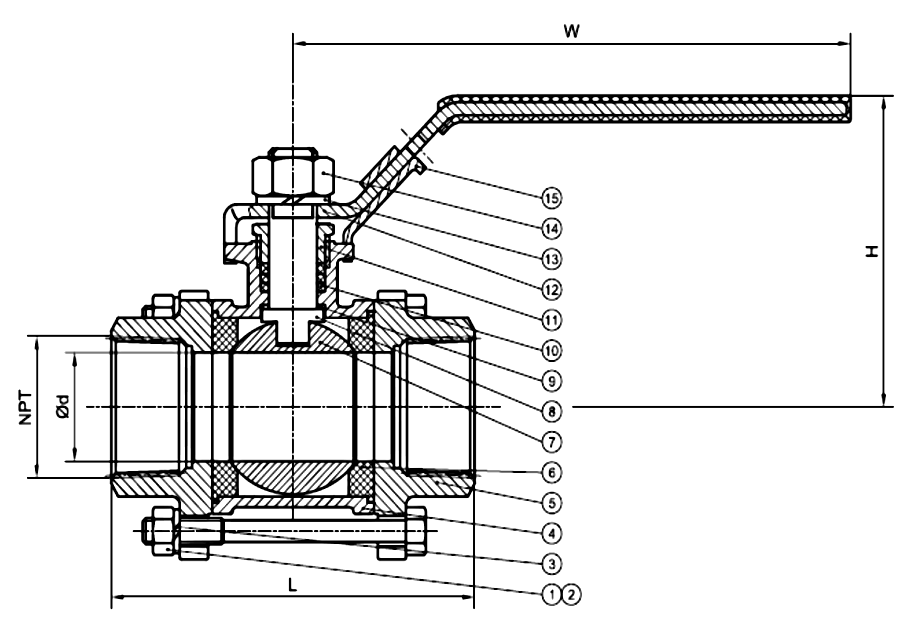
Threaded and socket weld. Numbered to match the parts list. The section shows the two end caps bolted to the centre body — the joints you undo to service it in the line — the full bore through the ball, and the PCD the size table lists.
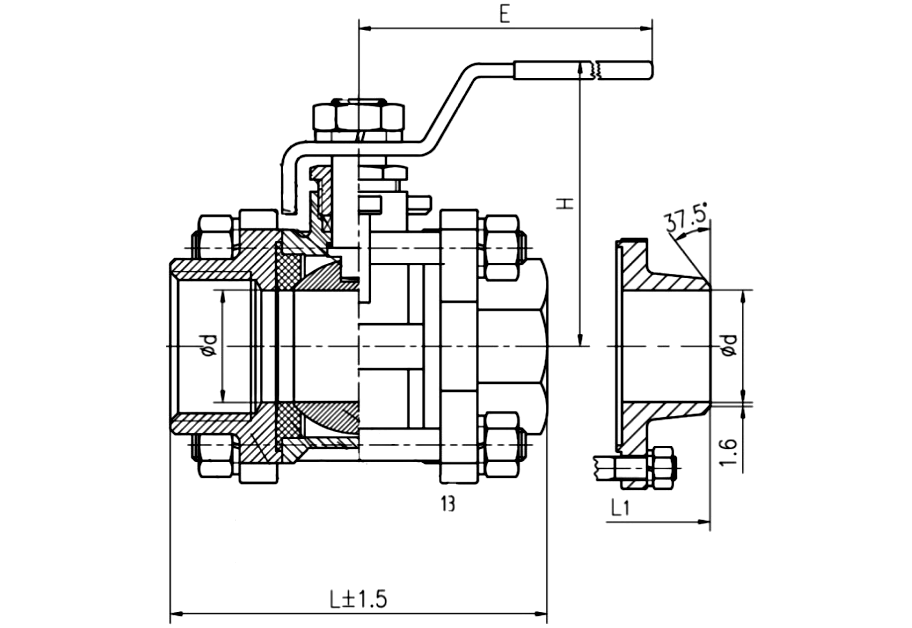
Butt weld end. The same valve with butt weld ends. The weld is on the end cap, not the body — which is why welding it in does not stop you lifting the centre section out later. Dimensions for this range are in their own table on this page.
| No | Part name | Material |
|---|---|---|
| 1 | Body | SS316 dan CF8M |
| 2 | Cap | SS316 |
| 3 | Ball | SS316 |
| 4 | Seal | PTFE |
| 5 | Bolt | SS304 |
| 6 | Gasket | SS301 |
| 7 | Stem nut | SS304 |
| 8 | Stem seal | PTFE |
| 9 | Stem | SS316 |
| 10 | Packing | PTFE |
| 11 | Packing gland | SS304 |
| 12 | Handle | SS201 |
| 13 | Spring washer | SS301 |
| 14 | Stem nut | SS304 |
SS304 bolts and an SS301 gasket appear in this list and not in the one-piece or two-piece lists — they are the parts that hold the two end caps onto the centre body, and the parts you undo to service it.
Body, cap, ball and stem in SS316; seat, seal, stem seal and packing in PTFE. Same trim as the other two constructions.
We publish the list as printed rather than silently deduplicating it — there may genuinely be two, or it may be a repetition in the source. Ask us if the exact count matters for a spares order.
That short list is identical to the one-piece and two-piece. The list above is the three-piece specific one, which is the one that includes the bolts.
Hence 150 °C. The derating curve is below.
1000 PSI is the cold figure. Read off the curve and interpolated along its straight section — treat these as approximate figures for selection and ask us to confirm any duty close to the limit.
| Temperature | Working pressure | Approx. PSI | Share of cold rating |
|---|---|---|---|
| −30 to +20 °C | 63 bar | 914 PSI | 100% |
| 40 °C | 59,8 bar | 867 PSI | 95% |
| 60 °C | 56,5 bar | 819 PSI | 90% |
| 80 °C | 53,3 bar | 773 PSI | 85% |
| 100 °C | 50,1 bar | 727 PSI | 80% |
| 120 °C | 46,8 bar | 679 PSI | 74% |
| 140 °C | 43,6 bar | 632 PSI | 69% |
| 150 °C | 42 bar | 609 PSI | 67% |
The 150 °C ceiling is set by the PTFE seat, not the SS316 body — and that applies equally to the welded and the threaded versions. ⚠ On the welded versions, keep welding heat away from the PTFE seat and seals: that is the part that limits the valve, and heat conducted along the end cap is what damages it.
63 bar cold, 42 bar hot — 67%. If you sized on the catalogue figure and the line runs warm, the margin you thought you had is not there.
The curve is flat from −30 °C, so ambient and chilled service get the full rating. Derating only begins once the line is warm.
The curve drops vertically to zero there. Do not design a small margin beyond it.
Unlike the two-piece, this construction is offered at 1000 PSI only. If you need 2000 PSI, that is the two-piece.
It is the PTFE seat that limits, and every stainless variant here uses the same seat material.
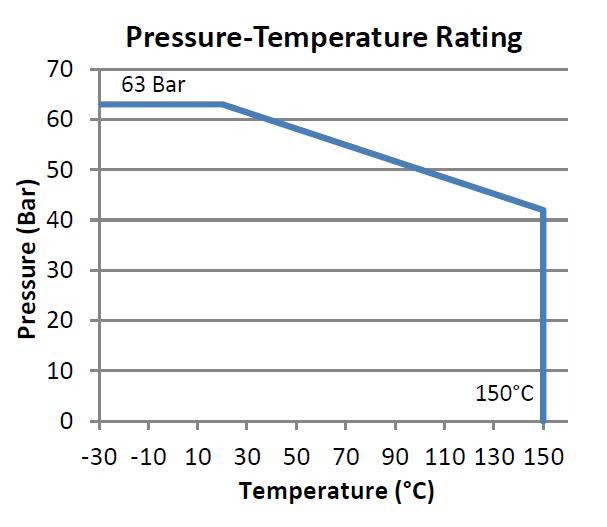
Flat, then falling, then a wall. 63 bar from −30 °C to about +20 °C, then a straight decline to 42 bar at 150 °C, where it drops vertically to zero.
It is the most capable of the three, and the most expensive.
All eight, side by side: the comparison table.
Dimensions and part numbers are in the catalogue, as printed; stock and price are not — send the list and we confirm both.
A ball valve that comprises three pieces: two end caps and a body, bolted together. The end caps are threaded, welded or flanged to connect to the pipe on both sides, and the design separates the connection portions of the valve assembly from the rest of the body. That means the centre section can be removed for service while the end caps stay in the pipework.
One reason, and it is usually decisive: the three-piece prevents a line shutdown if maintenance is required. Both are full bore and both can be re-seated, but a two-piece has to come out of the pipe to be opened. On a three-piece the end caps stay put. It is also the only variant offered with weld ends. It costs more; one avoided shutdown normally covers the difference.
Yes — that is what it is for. Undo the body bolts and the centre section lifts out while both end caps remain threaded or welded to the pipe. The pipe run is never broken, so there is no need to cut a weld, re-make a thread or drain a system to replace a seat. Depressurise and drain the section first, as you would for any valve work.
Yes, and this is the only variant in the range that is. There is socket weld within the main size table and a separate butt weld range from 3/8″ to 4″, alongside threaded BSPP and NPT. Because the weld is on the end cap rather than the valve body, welding it in does not stop you servicing it later.
They are confirmed per order. The butt weld table carries its codes in full (VL-S-B3-); for the threaded valve, state the size and end type on your enquiry and we confirm the order code with the factory before anything ships.
Yes. The bore through the ball equals the nominal pipe bore at every size — 15 mm at 1/2″, 25 mm at 1″, 50 mm at 2″ — so the valve does not restrict an open line. Same as the two-piece; the one-piece is always reduced bore.
Two — one at each end cap — against one on a two-piece and none on a one-piece. They are gasketed, bolted joints and they are not a weakness in normal service, but it is the honest trade: more access means more sealing surfaces. If minimising leak paths is the priority above all else, the one-piece is a single casting.
The pitch circle diameter of the body bolts — the circle the bolts holding the three pieces together sit on. 1/4″ and 3/8″ do not carry one in the source; it is published for every size from 1/2″ up, so you can check socket or torque-wrench access before the valve arrives.
1000 PSI cold, and −29 to 150 °C. Unlike the two-piece there is no 2000 PSI version of this construction. The PSI figure is an ambient rating: the curve falls to about 67% of it at 150 °C, and the limiting part is the PTFE seat.
SS316 body, cap, ball and stem (CF8M where cast); PTFE seat, seal, stem seal and packing; SS304 body bolts, stem nuts and packing gland; SS301 gasket and spring washer; SS201 handle. The bolts and gasket are the parts unique to this construction.
Held in our Singapore and Malaysia warehouses, out within 24 hours of your PO; quotes within 2 working hours.
Related: all ball valves · two-piece if the line can be stopped · class 150 threaded fittings for the pipework.