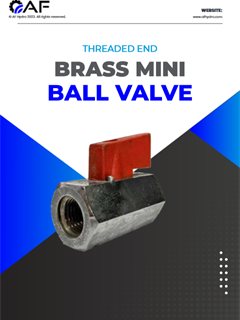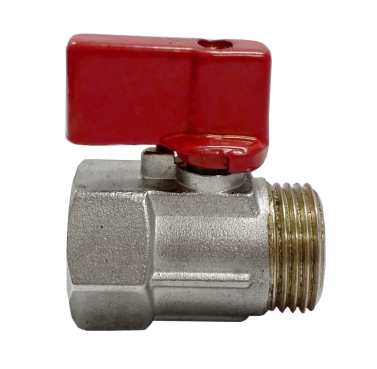
A compact brass quarter-turn valve, male × female, for gauge, drain and small isolation points where a full-size body will not fit. 1/4″ to 3/4″ at 300 PSI. BSPP only — there is no NPT option in this range.
State the size and the space you have — the lever still needs a clear 90° sweep. Quotes within 2 working hours.
| Pattern | Male × female — no adaptor |
|---|---|
| Range | 1/4″ to 3/4″ (DN8–DN20) |
| Bore | Reduced bore — an isolation valve, not a flow device |
| Pressure | 300 PSI cold |
| Temperature | −29…150 °C |
| Body | Brass; chrome-plated brass ball |
| Ends | BSPP only — no NPT |
| Operation | Quarter turn manual lever |
The four-size dimension table with part numbers, the 8-item bill of materials and the sectional drawing are all on this page, as printed in the catalogue.
Small isolation, where a full-size valve will not fit.
A mini ball valve does the same quarter-turn job as the full-size valves on this range, in a much smaller body. It is a male × female pattern, which means it screws directly into a female port and presents a female thread on the other side — so it drops straight into a gauge tapping, a drain point, a sample point or an instrument line without an adaptor.
It is the only variant on this range offered in BSPP alone. Every other one is available in NPT as well, so if your pipework is NPT this valve is not an option — use the SS316 mini, which is offered in both.
That is a third of every stainless variant on this range. If you need more from a compact body, the SS316 mini is 1000 PSI in the same sizes.
Body, cap and stem are brass and the ball is chrome-plated brass, but the handle is aluminium, the nut is steel and the O-ring is NBR. The steel nut is the part to watch in a damp installation.
The male end goes into the existing port and the female end takes the gauge or the tube fitting. On a crowded manifold, not needing an extra nipple is often the reason this valve gets specified.
These are isolation valves for instrument and drain duty, not flow devices. Bore figures are in the table.
It still needs a clear 90° sweep, and on a small valve in a tight cluster that is easy to overlook. Check the width and length columns before ordering.
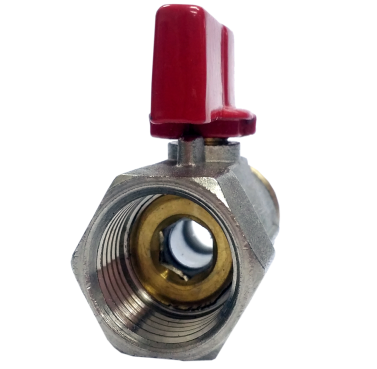
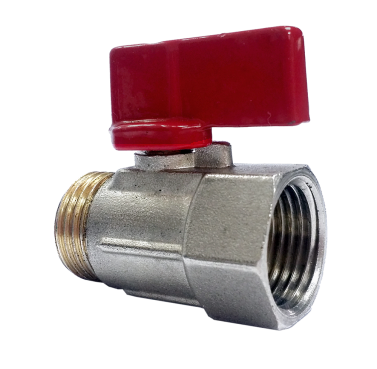
All photographs of the stocked item, not renders.
One end male, one end female. It threads straight into an existing port and presents a female thread for the gauge or fitting — no adaptor needed.
The whole valve is not much bigger than the thread. Which is the reason to choose it — and the reason the bore is reduced.
Still 90° of travel. Check the swing clearance on a crowded manifold — a small valve still needs a full quarter turn to seal.
Everything that goes on a purchase order.
| Item | Detail |
|---|---|
| Size range | 1/4″ to 3/4″ (DN8 to DN20) |
| Pattern | Male × female — threads into a female port, presents a female thread |
| Body material | Brass |
| Working pressure | 300 PSI cold — derate for temperature |
| Working temperature | −29 °C to 150 °C |
| Connection type | BSPP only — there is no NPT option in this variant |
| Bore | Reduced bore — an isolation valve, not a flow device |
| Seat | PTFE |
| Operation | Quarter turn manual lever |
| Typical duty | Gauge tappings, drain and sample points, instrument isolation |
| Stock | Singapore and Malaysia warehouses — out within 24 hours |
4 sizes, dimensions in millimetres. Check the width B and length L against the space you have — on a crowded gauge manifold these are the dimensions that decide whether the valve fits, and the lever still needs a clear 90° sweep.
| Size | Bore D | Height H | Length L | Width B | Weight (kg) | Part no, BSPP |
|---|---|---|---|---|---|---|
| 1/4″ | 8 | 27 | 40 | 22 | 0.06 | VL-B-BMF-G-300-04-NI |
| 3/8″ | 8 | 27 | 41 | 22 | 0.08 | VL-B-BMF-G-300-06-NI |
| 1/2″ | 10 | 29 | 44 | 22 | 0.09 | VL-B-BMF-G-300-08-NI |
| 3/4″ | 13 | 33 | 53 | 22 | 0.13 | VL-B-BMF-G-300-12-NI |
These are isolation valves — sized to shut off a small line reliably, not to pass maximum flow. If you need flow, use a full-size full-bore valve.
1/4″ and 3/8″ carry the same bore, height and width — machined from the same blank with a different thread, so the physical envelope does not change even though the connection does.
Across all four sizes. If the valve has to sit between two closely spaced tappings, that is the one figure to check.
So these can generally be carried on the tubing — but a gauge hanging off one is a different matter, and that wants supporting.
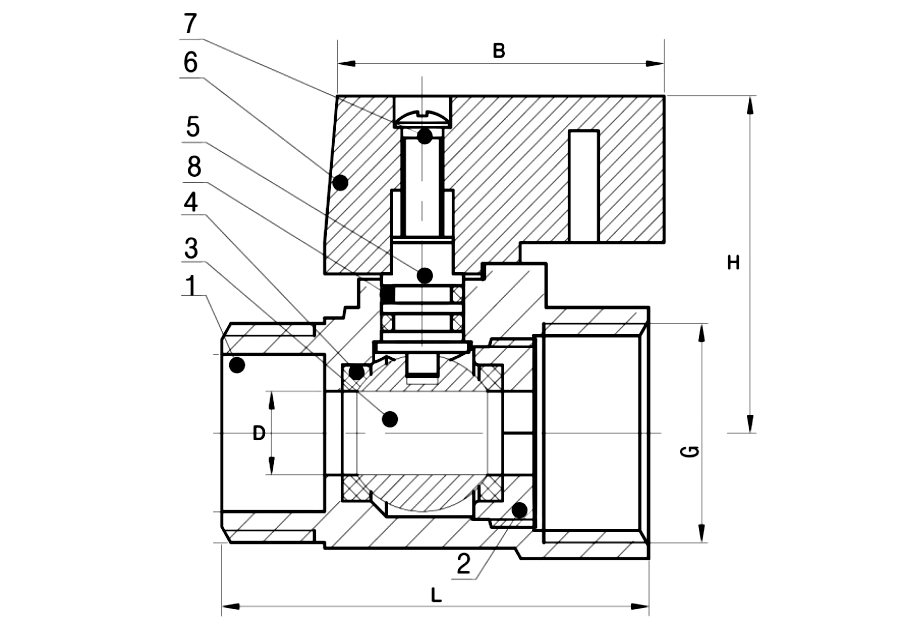
Numbered to match the parts list below. The section shows the compact brass body, the male × female pattern with one end threaded outside and one inside, and the reduced bore through the chrome-plated ball.
| No | Part name | Material |
|---|---|---|
| 1 | Body | Brass |
| 2 | Cap | Brass |
| 3 | Seat | PTFE |
| 4 | Ball | Chrome-plated brass |
| 5 | Stem | Brass |
| 6 | Handle | Aluminium |
| 7 | O-Ring | NBR |
| 8 | Nut | Steel |
Body, cap and stem are brass and the ball is chrome-plated brass, but the handle is aluminium, the nut is steel and the O-ring is NBR. The steel nut is the part to watch in a damp installation.
Which is what sets the 150 °C ceiling and why the pressure rating falls as the line warms.
The full-size stainless two-piece lists thirteen. Fewer parts in a smaller body — which is why it fits, and why it does less.
Lighter and cheaper than a stainless lever, and outside the pressure boundary — but it is the part most likely to be knocked or corroded on an exposed installation.
300 PSI is the cold figure. The temperature ceiling is set by the PTFE seat, and roughly two thirds of the cold rating is left at 150 °C. Apply the shares below to the 300 PSI figure.
| Temperature | Share of cold rating |
|---|---|
| −30…+20 °C | 100% |
| 40 °C | 95% |
| 60 °C | 90% |
| 80 °C | 85% |
| 100 °C | 80% |
| 120 °C | 74% |
| 140 °C | 69% |
| 150 °C | 67% |
These are read off the manufacturer's curve as proportions of the cold rating. Treat them as approximate for selection — for any duty near the limit, give us the pressure and the temperature together and we confirm against the specific part number.
A mini valve is chosen on space first, then pressure.
All eight, side by side: the comparison table.
Dimensions and part numbers are in the catalogue, as printed; stock and price are not — send the list and we confirm both.
Small isolation where a full-size valve will not fit — gauge tappings, drain and sample points, and instrument lines. It is a male × female pattern, so it threads directly into an existing female port and presents a female thread for the gauge or tube fitting, saving an adaptor on a crowded manifold.
One end has a male thread and the other a female thread. The male end screws into the port you are isolating; the female end receives the gauge, the tube fitting or the next component. It means you can add isolation to an existing tapping without adding a nipple.
300 PSI cold. That is the same as the full-size brass valve and about a third of every stainless variant on this range. If you need more from a compact body, the SS316 mini gives 1000 PSI in overlapping sizes. Both figures derate as the line warms: about 67% at 150 °C.
BSPP only. This is the one variant on the whole range without an NPT option — so if your pipework is NPT, use the SS316 mini instead, which is offered in both. BSPP and NPT are not interchangeable: a mismatched pair engages, feels tight, and leaks later.
1/4″ in this variant. For smaller, the SS316 mini goes down to 1/8″ (DN6) — it is the only variant on the range that does.
Brass body, cap and stem, with a chrome-plated brass ball and a PTFE seat. The handle is aluminium, the nut is steel and the O-ring is NBR — so it is not an all-brass valve, and the steel nut is the first part to show corrosion in a damp installation.
No — reduced bore, and deliberately so. A mini valve exists to shut off a small line in a small space, not to pass maximum flow. The bore figures are in the size table. If flow matters, use a full-size full-bore two-piece.
Pressure and environment decide it. The SS316 mini is 1000 PSI; this one is 300 PSI. Choose SS316 for higher pressure, corrosive or marine service, or where you need NPT; choose brass for water and air at modest pressure where cost rules. The SS316 mini · all eight compared.
Held in our Singapore and Malaysia warehouses, out within 24 hours of your PO; quotes within 2 working hours.
Related: SS316 mini for 1000 PSI or NPT · full-size brass · all ball valves.