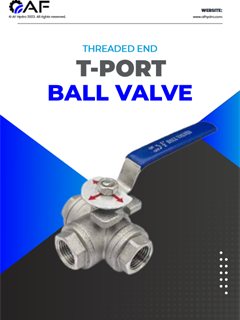
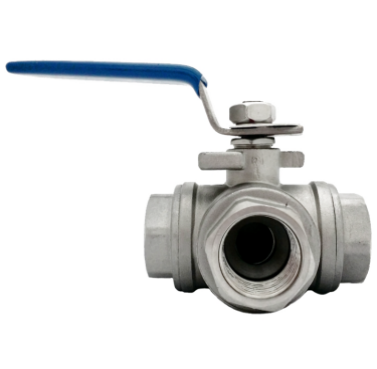
A three-way ball valve with a T-drilled ball, which can connect all three ports at once — so it will mix, split or divert, which an L-port cannot. SS316, 1000 PSI, 1/4″ to 2″, threaded BSPP or NPT. One valve where you would otherwise need two plus a tee.
Tell us what has to connect to what — we confirm T-port or T-port and the handle-to-port mapping. Quotes within 2 working hours.
| Ports | Three, T-drilled ball — mixes, splits or diverts |
|---|---|
| Range | 1/4″ to 2″ (DN8–DN50) |
| Bore | Reduced bore — normal for a three-way |
| Pressure | 1000 PSI cold — derate for temperature |
| Temperature | −29…150 °C |
| Body | SS316, CF8M where cast |
| Ends | Threaded BSPP or NPT |
| Part prefix | VL-S-BT- |
The eight-size dimension table with part numbers, the 11-item bill of materials, the sectional drawing and the handle-position drawing are all on this page, as printed in the catalogue.
Same body as the L-port. Different hole through the ball.
A three-way ball valve has three threaded ports instead of two, and a ball drilled so that turning the handle changes which ports are connected to which. It replaces a pair of two-way valves and a tee with a single body and a single quarter-turn action.
The letter describes the shape of the passage drilled through the ball. A T-port ball can join all three ports at once, so it mixes, splits or diverts. That is the functional difference between this valve and the L-port, and it is the only difference — the two share the same body, the same face-to-face dimensions and the same weights, right across the range.
The three-way pair runs 1/4″ to 2″ (DN8–DN50), where the two-piece and one-piece go to 4″. Above 2″ a three-way function has to be built from two-way valves.
At 1/2″ the bore is 10 mm. Getting a full passage through a ball in two directions is not geometrically possible at the same diameter — if flow area through the diverter is critical, use two full-bore two-way valves instead.
This range is VL-S-BT- against the L-port's prefix. Since the valves are dimensionally identical, the part number is the only thing on paper that tells them apart — worth double-checking on an order.
How the handle angle maps to which ports are open varies with how the ball and stem are keyed. We will confirm the port marking and handle mapping for the specific part rather than guess.
Unlike the two-way valves, the three-way has a bonnet rather than a screwed-in cap — see the bill of materials.
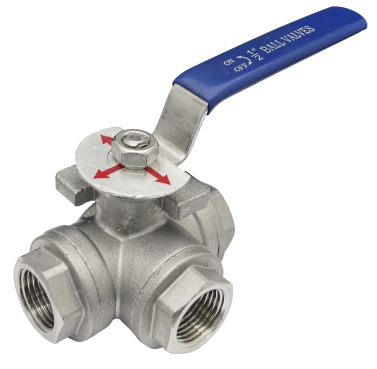
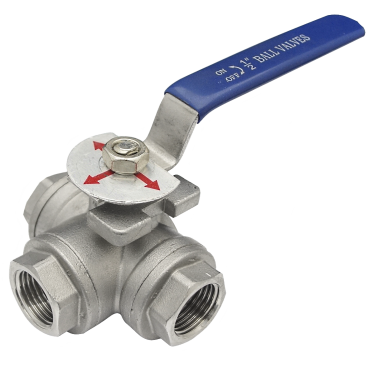
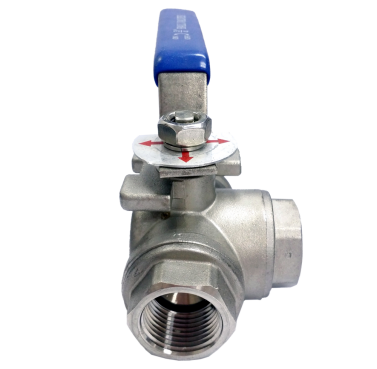
All photographs of the stocked item, not renders.
Two in line, one at right angles. The third port is what removes a tee and a second valve from the pipework.
The handle selects the path. Confirm the marking on your specific valve — the mapping from handle angle to open ports depends on how the ball is keyed to the stem.
A bolted bonnet, not a screwed cap. Which is why the parts list reads differently from the two-way valves on this range.
Straight into the port. The two side ports sit either side of the one you are looking into. This is the shared three-way body — it is identical on the L-port, because only the drilling inside the ball differs.
Everything that goes on a purchase order.
| Item | Detail |
|---|---|
| Size range | 1/4″ to 2″ (DN8 to DN50) |
| Ports | Three, with a T-drilled ball — can join all three ports at once, so it mixes, splits or diverts |
| Bore | Reduced bore, as is normal for a three-way ball |
| Body material | Stainless steel SS316, with CF8M where the part is cast |
| Working pressure | 1000 PSI cold — derate for temperature |
| Working temperature | −29 °C to 150 °C |
| Connection type | Threaded BSPP or NPT |
| Seat and seals | PTFE seat, gasket, thrust gasket |
| Ball and stem | SS316, in an SS304 gland |
| Operation | Quarter turn manual lever |
| Part number prefix | VL-S-BT- — the only thing that distinguishes it from the L-port on paper |
| Stock | Singapore and Malaysia warehouses — out within 24 hours |
8 sizes. BSPP and NPT share every dimension. Dimensions in millimetres: d is the bore through the ball, L the face-to-face length, H the overall height including the stem, and T the distance to the third port centre — the dimension you need when laying out the branch.
| Size | Bore d | Length L | Height H | Port centre T | Weight (kg) | Part no, BSPP | Part no, NPT |
|---|---|---|---|---|---|---|---|
| 1/4″ | 6 | 65.5 | 100 | 51 | 0.58 | VL-S-BT-G-1000-04 | VL-S-BT-N-1000-04 |
| 3/8″ | 6 | 65.5 | 100 | 51 | 0.55 | VL-S-BT-G-1000-06 | VL-S-BT-N-1000-06 |
| 1/2″ | 10 | 75.5 | 100 | 57 | 0.52 | VL-S-BT-G-1000-08 | VL-S-BT-N-1000-08 |
| 3/4″ | 15 | 82.5 | 108 | 62 | 0.71 | VL-S-BT-G-1000-12 | VL-S-BT-N-1000-12 |
| 1″ | 20 | 88 | 140 | 72 | 0.98 | VL-S-BT-G-1000-16 | VL-S-BT-N-1000-16 |
| 1¼″ | 25 | 105 | 152 | 88 | 2.18 | VL-S-BT-G-1000-20 | VL-S-BT-N-1000-20 |
| 1½″ | 32 | 135 | 166 | 100 | 3.17 | VL-S-BT-G-1000-24 | VL-S-BT-N-1000-24 |
| 2″ | 39 | 149 | 170 | 102 | 4.38 | VL-S-BT-G-1000-32 | VL-S-BT-N-1000-32 |
Across the whole range — verified row by row. Only the part number changes. They are still not interchangeable with each other.
Same bore, same length, same height, same port centre, same weight, at every one of the 8 sizes. Only the part number prefix and the drilling differ — so you can substitute one for the other without touching the pipework, and you can also order the wrong one without noticing. Check the prefix.
Same 65.5 mm length, same 100 mm height, and the weight is actually marginally lower — 0.55 against 0.58 kg. Both sizes are machined from the same casting.
10 mm at 1/2″, 20 mm at 1″, 39 mm at 2″ — expect a pressure drop and size on flow rather than on the thread.
2″ is 4.38 kg against 0.98 kg at 1″, so support the valve rather than hanging it on the pipework.
The callout numbers on the sectional drawing correspond to the part numbers in the bill of materials below.
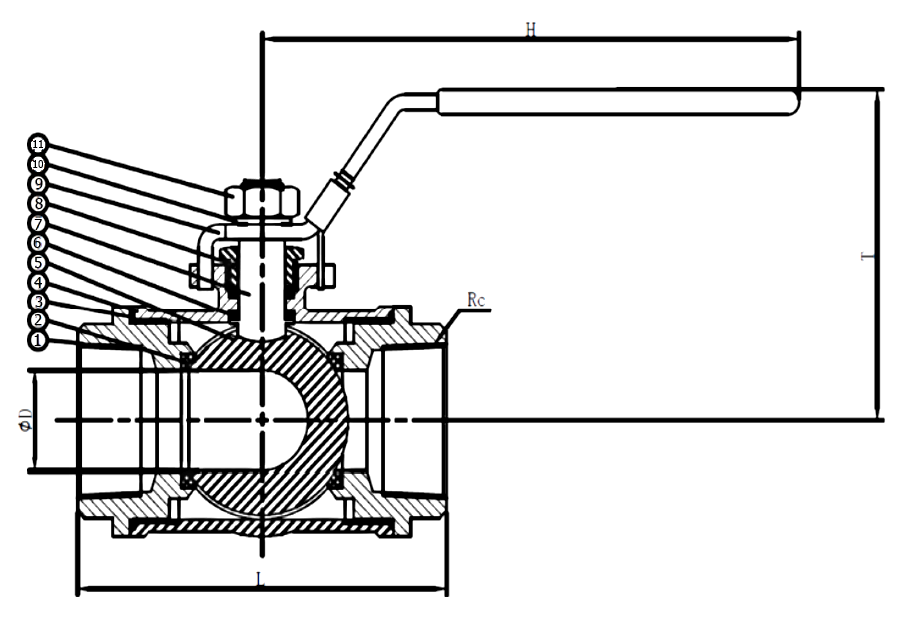
Sectional drawing. Callouts 1 to 11, matching the parts list exactly. The section shows the T-drilled ball — the passage branches inside it, which is what lets all three ports connect at once — the bonnet above, and the dimensions L, H, T and the bore ØD.
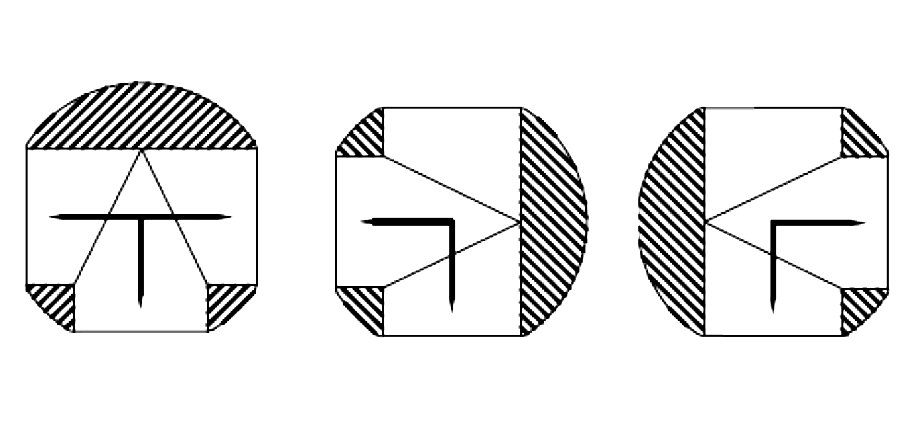
The three positions. All three ports joined, or the common port to either side. That is what lets a T-port mix or split flow — and why, with all three joined, it does not isolate one branch from the other.
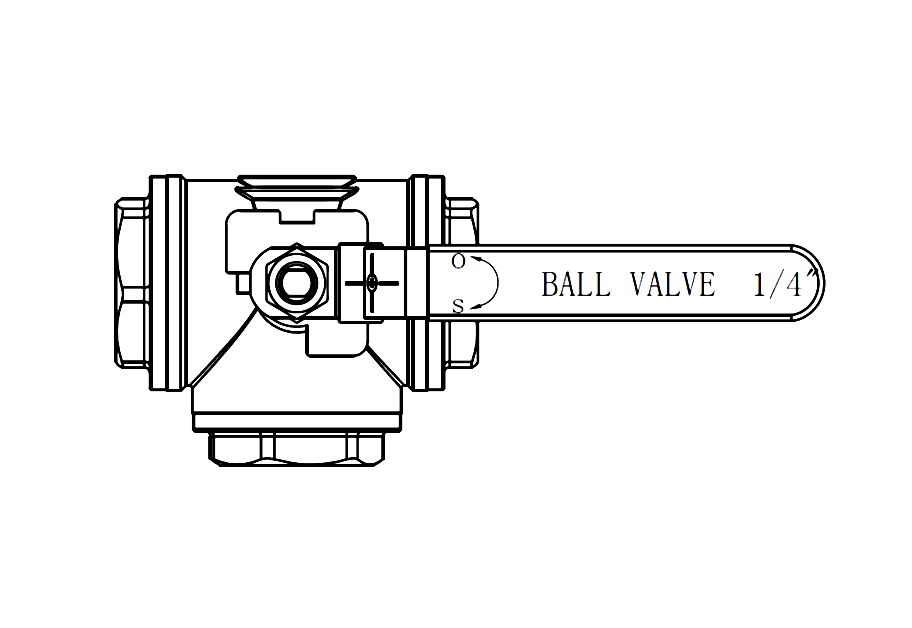
General arrangement. The manufacturer's outline drawing. Two side ports, the third port under the body, and the lever marked O and S sweeping 90°.
| No | Part name | Material |
|---|---|---|
| 1 | Bonnet | SS316 and CF8M |
| 2 | Seat | PTFE |
| 3 | Gasket | PTFE |
| 4 | Body | SS316 and CF8M |
| 5 | Ball | SS316 |
| 6 | Thrust Gasket | PTFE |
| 7 | Stem | SS316 |
| 8 | Gland | SS304 |
| 9 | Handle | SS201 |
| 10 | Washer | SS304 |
| 11 | Nut | SS304 |
Bonnet, body, ball and stem in SS316 (with CF8M where cast); seat, gasket and thrust gasket in PTFE.
A ball with three openings is less evenly supported than a two-way ball, and the PTFE thrust gasket takes the axial load. It does not appear in the two-way parts lists.
The two-way valves on this range have a screwed cap; this one has a bonnet. Same idea, different assembly, and it is why the numbering differs from the two-piece.
The one, two and three-piece two-way valves list an SS304 anti-static device; this list does not. If you are on hydrocarbon duty and need the ball bonded to the body, tell us and we will confirm with the factory before you order.
Not the stainless — hence 150 °C. The derating curve is below.
| Temperature | Pressure (bar) | Pressure (PSI) | Share of cold rating |
|---|---|---|---|
| −30…+20 °C | 63 | 914 | 100% |
| 40 °C | 59.8 | 867 | 95% |
| 60 °C | 56.5 | 819 | 90% |
| 80 °C | 53.3 | 773 | 85% |
| 100 °C | 50.1 | 727 | 80% |
| 120 °C | 46.8 | 679 | 74% |
| 140 °C | 43.6 | 632 | 69% |
| 150 °C | 42 | 609 | 67% |
Read off the manufacturer's curve and interpolated along its straight section. Treat these as approximate figures for selection and ask us to confirm any duty close to the limit.
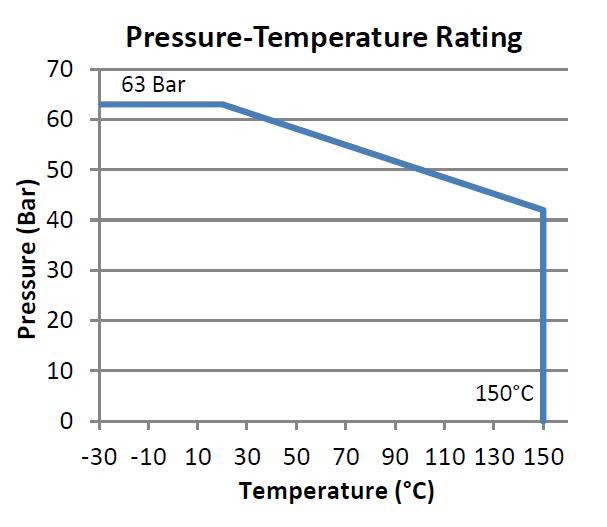
Flat, then falling, then a wall. 63 bar from −30 °C to about +20 °C, then a straight decline to 42 bar at 150 °C, where it drops vertically to zero. The limiting part is the PTFE seat, not the stainless body.
The choice between L and T is about how many ports you need open at once.
All eight, side by side: the comparison table.
Dimensions and part numbers are in the catalogue, as printed; stock and price are not — send the list and we confirm both.
A three-way ball valve with a T-shaped passage drilled through the ball. It has three ports instead of two, and the handle selects which are connected. A T-port can join all three ports at once, so it mixes, splits or diverts. It replaces two two-way valves and a tee with one body and one quarter-turn action.
Only how the ball is drilled — and therefore what the valve can do. An L-port connects two ports at a time, so it diverts flow or shuts off. A T-port can connect all three at once, so it will mix, split or divert. Mechanically they are the same valve: identical bodies, dimensions and weights at every size.
Yes. Every published dimension is identical — bore, face-to-face length, height, port centre distance and weight, at all sizes from 1/4″ to 2″. The flip side is that you can order the wrong one and not see it until it is fitted, so check the part number prefix — this range is VL-S-BT-.
1/4″ to 2″ (DN8 to DN50), in both BSPP and NPT. Note this is narrower than the two-way range, which runs to 4″ — above 2″ a three-way function has to be built from two-way valves and a tee.
No — reduced bore, and that is normal for the type rather than a compromise on this particular valve. You cannot drill a full-size passage through a ball in two directions at once. At 1/2″ the bore is 10 mm, at 1″ it is 20 mm, and at 2″ it is 39 mm.
Ask us to confirm it for the specific part. The mapping from handle angle to open ports depends on how the ball is keyed to the stem, and it is not something to assume from a general diagram — a three-way plumbed on the wrong assumption sends flow to the wrong place.
1000 PSI and −29 °C to 150 °C. The PSI is a cold rating — the curve is flat to about 20 °C then falls to roughly 67% of it at 150 °C, because the limiting part is the PTFE seat rather than the stainless body.
SS316 bonnet, body, ball and stem (CF8M where cast); PTFE seat, gasket and thrust gasket; SS304 gland, washer and nut; SS201 handle. The thrust gasket is specific to the three-way. Note this list does not include an anti-static device; ask us if you need one.
Held in our Singapore and Malaysia warehouses, out within 24 hours of your PO; quotes within 2 working hours.
Related: L-port three-way · all ball valves · class 150 threaded fittings for the branch pipework.