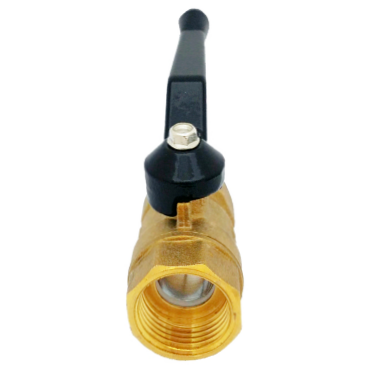
A two-piece brass quarter-turn valve for water, air and non-corrosive duty, with a near-full bore and IMPA codes across the common sizes. Rated 300 PSI — roughly a third of the stainless variants on this range, so read that before substituting on price.
State the size, BSPP or NPT, and the fluid and working pressure — quotes within 2 working hours.
| Construction | Two piece — serviceable off the line |
|---|---|
| Range | 1/4″ to 4″ (11 sizes) |
| Bore | Near-full bore — 85–100% of nominal |
| Pressure | 300 PSI — a third of the stainless |
| Temperature | −29…150 °C |
| Body | Brass; chrome-plated brass ball |
| Seals | PTFE seat, NBR O-ring |
| IMPA codes | 75 24 01–07 (3/8″–2″) |
The eleven-size dimension table with part numbers and IMPA codes, the 8-item bill of materials and the sectional drawing are all on this page, as printed in the catalogue.
The right valve for plenty of duties. Read the pressure first.
A brass ball valve does the same job as the stainless ones on this range — a quarter-turn shut-off for water, air and other non-corrosive service — at a lower cost. It is a two-piece construction, with a near-full bore, and it is fully IMPA coded across the common sizes, which makes it straightforward to order for marine and general industrial work.
The thing to know before anything else is the pressure. This valve is rated 300 PSI. Every stainless variant on this range is 1000 PSI, and the two-piece reaches 2000. So brass is roughly a third of the stainless rating — which is fine when the duty suits it, and a false economy when the duty was specified around a stainless figure. It is not a like-for-like substitution.
If a drawing or a previous order specified a 1000 PSI ball valve, brass does not replace it. Check the duty before switching on price. All eight compared.
The body, bonnet and stem are brass and the ball is chrome-plated brass — but the handle is aluminium, the nut is steel, and the O-ring is NBR. On a wet or salty installation the steel nut is the part that will show first.
The bore runs 85% to 100% of nominal diameter across the range — 8 mm at 1/4″ is exactly DN8, and 14 mm at 1/2″ is close to DN15. Much better than the one-piece stainless, which is 9 mm at 1/2″.
75 24 01 to 75 24 07, so a purchasing department can order against the code it already uses.
NBR handles oil, water, grease and air well. It is not the material for steam or strong chemicals — for those, the stainless variants with all-PTFE sealing are the better answer.
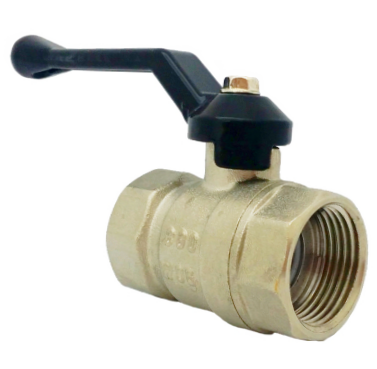
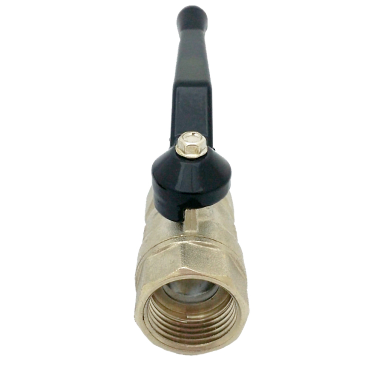
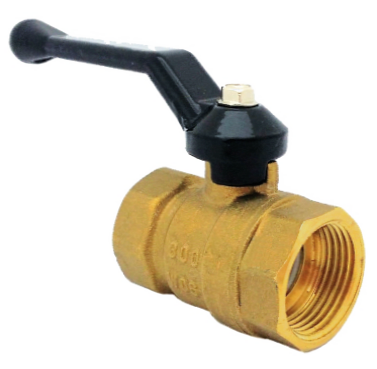
All photographs of the stocked item, not renders.
The handle is not brass. Body, bonnet and stem are brass; the lever is aluminium and the nut holding it is steel — worth knowing on a wet installation.
85 to 100% of nominal diameter. Better flow than a reduced-bore stainless one-piece — the bore is the one place brass beats the cheapest stainless option.
The same construction as the stainless two-piece. It can be opened to replace the trim, and it carries one body joint — the difference here is the material, not the design.
Where the non-brass parts are. The aluminium lever and the steel nut holding it sit here — items 6 and 7 on the parts list, and the first parts to show corrosion on a damp installation.
Everything that goes on a purchase order.
| Item | Detail |
|---|---|
| Size range | 1/4″ to 4″ (DN8 to DN100) |
| Body construction | Two piece — serviceable off the line |
| Bore | Near-full bore — 85% to 100% of nominal diameter across the range |
| Body material | Brass body, bonnet and stem |
| Ball | Chrome-plated brass |
| Working pressure | 300 PSI — a third of the stainless variants |
| Working temperature | −29 °C to 150 °C — pressure derates with temperature |
| Connection type | Threaded BSPP or NPT |
| Seat | PTFE |
| O-ring | NBR — suits oil, water, grease and air; not steam or strong chemicals |
| Handle and nut | Aluminium handle, steel nut — not brass |
| IMPA codes | 75 24 01 to 75 24 07 (3/8″ to 2″) |
| Stock | Singapore and Malaysia warehouses — out within 24 hours |
11 sizes. BSPP and NPT share every dimension. Dimensions in millimetres, with the letters as they appear on the catalogue drawing: A is the bore through the ball; D is the handle length, which needs a clear 90° sweep.
| Size | Bore A | B | C | Handle D | Weight (kg) | Part no, BSPP | Part no, NPT | IMPA, BSPP |
|---|---|---|---|---|---|---|---|---|
| 1/4″ | 8 | 39 | 40.0 | 86 | 0.08 | VL-B-B2-G-300-04-NI | VL-B-B2-N-300-04-NI | — |
| 3/8″ | 10 | 42 | 41.5 | 86 | 0.10 | VL-B-B2-G-300-06-NI | VL-B-B2-N-300-06-NI | 75 24 01 |
| 1/2″ | 14 | 46.4 | 45.5 | 86 | 0.11 | VL-B-B2-G-300-08-NI | VL-B-B2-N-300-08-NI | 75 24 02 |
| 3/4″ | 18 | 51 | 48.0 | 86 | 0.15 | VL-B-B2-G-300-12-NI | VL-B-B2-N-300-12-NI | 75 24 03 |
| 1″ | 24 | 64.5 | 60.5 | 95 | 0.35 | VL-B-B2-G-300-16-NI | VL-B-B2-N-300-16-NI | 75 24 04 |
| 1¼″ | 31 | 76 | 73.5 | 115 | 0.65 | VL-B-B2-G-300-20-NI | VL-B-B2-N-300-20-NI | 75 24 05 |
| 1½″ | 39 | 85 | 78.5 | 115 | 0.83 | VL-B-B2-G-300-24-NI | VL-B-B2-N-300-24-NI | 75 24 06 |
| 2″ | 46 | 93 | 101.5 | 147 | 1.18 | VL-B-B2-G-300-32-NI | VL-B-B2-N-300-32-NI | 75 24 07 |
| 2½″ | 58 | 119 | 113.0 | 185 | 2.12 | VL-B-B2-G-300-40-NI | VL-B-B2-N-300-40-NI | — |
| 3″ | 69 | 133 | 128.0 | 227 | 3.25 | VL-B-B2-G-300-48-NI | VL-B-B2-N-300-48-NI | — |
| 4″ | 85 | 167 | 138.0 | 227 | 5.52 | VL-B-B2-G-300-64-NI | VL-B-B2-N-300-64-NI | — |
Across the whole range — verified row by row. Only the part number changes, and they are not interchangeable with each other.
8 mm at 1/4″ is exactly DN8; 39 mm at 1½″ is 98% of DN40. It tapers at the top — 85 mm at 4″ is 85% of DN100, which is about 72% of the flow area.
1/4″ to 3/4″ all use D = 86 mm, so the small sizes need the same swing clearance regardless of the thread.
75 24 01 through 75 24 07 on the BSPP rows. 1/4″, 2½″, 3″ and 4″ have no published code, and neither do the NPT rows — order those by part number.
Compared with the stainless one-piece at the same size — brass is lighter as well as cheaper, which occasionally matters more than either.
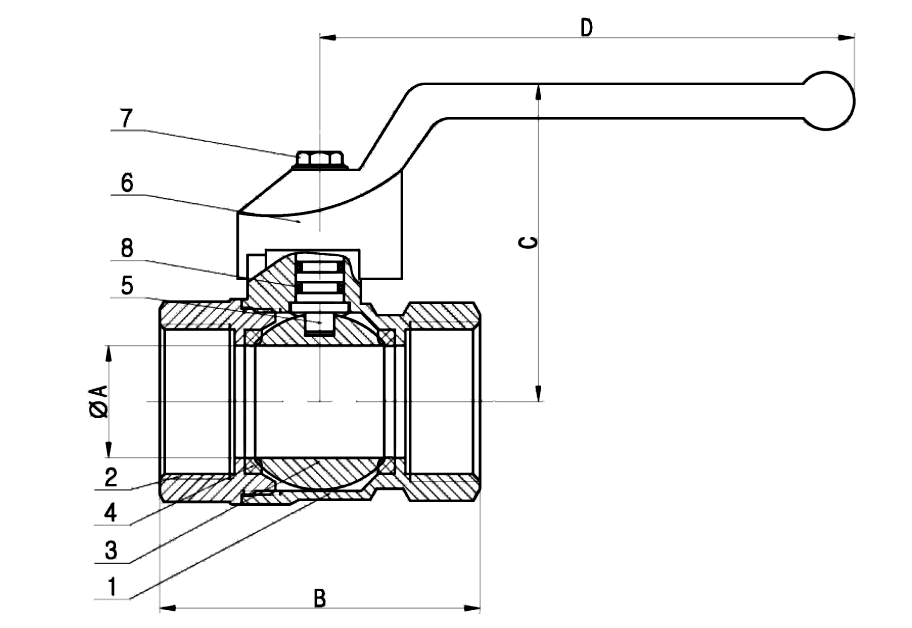
Numbered to match the parts list below. The section shows the two-piece brass body, the near-full bore through the chrome-plated ball, and the dimensions the size table lists as A, B, C and D.
| No | Part name | Material |
|---|---|---|
| 1 | Body | Brass |
| 2 | Bonnet | Brass |
| 3 | Ball | Chrome-plated brass |
| 4 | Seat | PTFE |
| 5 | Stem | Brass |
| 6 | Handle | Aluminium |
| 7 | Nut | Steel |
| 8 | O-Ring | NBR |
The seat is PTFE, the handle is aluminium, the nut is steel and the O-ring is NBR. On a valve sold as “brass”, the steel nut is the one to watch in a damp or coastal installation.
Plating gives a harder, smoother surface for the PTFE seat to run against than bare brass would — it is what makes the valve turn easily and seal repeatedly.
NBR is excellent on oil, water, grease and air. It is the wrong material for steam, strong acids or aromatic hydrocarbons. The stainless variants seal on PTFE throughout and handle far more.
The stainless one, two and three-piece valves list an SS304 anti-static device; this one does not. If you need the ball bonded to the body, specify stainless.
A simpler valve, which is part of why it costs less — and part of why it does less.
300 PSI is the cold figure. The temperature ceiling is set by the PTFE seat, and the same manufacturer's curve applies as a proportion: roughly two thirds of the cold rating is left at 150 °C. Apply the shares below to the 300 PSI figure.
| Temperature | Share of cold rating |
|---|---|
| −30…+20 °C | 100% |
| 40 °C | 95% |
| 60 °C | 90% |
| 80 °C | 85% |
| 100 °C | 80% |
| 120 °C | 74% |
| 140 °C | 69% |
| 150 °C | 67% |
These are read off the manufacturer's curve as proportions of the cold rating. Treat them as approximate for selection — for any duty near the limit, give us the pressure and the temperature together and we confirm against the specific part number.
Cheaper and lighter. Also a third of the pressure.
All eight, side by side: the comparison table. Need a smaller body? The brass mini runs 1/4″ to 3/4″ at the same 300 PSI, BSPP only.
Dimensions and part numbers are in the catalogue, as printed; stock and price are not — send the list and we confirm both.
300 PSI. That is the single most important number on this page, because every stainless variant on this range is 1000 PSI and the two-piece also comes in 2000 PSI. Brass is roughly a third of the stainless rating, so it is not a drop-in substitution for a valve specified around a stainless figure. And 300 PSI is a cold rating — it derates as the line warms.
Often yes, but check two things. First the pressure: brass is 300 PSI against 1000. Second the fluid: the O-ring is NBR, which is good for oil, water, grease and air but wrong for steam and strong chemicals, and SS316 is specified on this range for its high corrosion resistance. For clean water and compressed air at modest pressure, brass is a sound and cheaper choice.
No — and it is worth knowing which parts are not. Body, bonnet and stem are brass, and the ball is chrome-plated brass. But the seat is PTFE, the handle is aluminium, the nut is steel and the O-ring is NBR. In a damp or coastal installation the steel nut is usually the first part to show corrosion.
Close to it — 85% to 100% of nominal diameter across the range. 8 mm at 1/4″ is exactly DN8, 14 mm at 1/2″ is 93% of DN15, and it tapers to 85 mm at 4″, about 72% of the flow area. That is better than the reduced-bore stainless one-piece, though not as good as the full-bore two-piece.
Two piece — the same construction as the stainless two-piece, so it can be opened to replace the trim and it carries one body joint. The difference between this valve and that one is the material and the pressure rating, not the design.
The NBR O-ring sets the limit more than the brass does. NBR is resistant to oil-based hydraulic fluid, grease, water and air, which covers most general service. It is not suitable for steam, strong acids or aromatic hydrocarbons. Tell us the fluid and we will say whether brass is appropriate.
Both, and they are dimensionally identical — every bore, dimension and weight matches across the two thread forms, so only the part number changes. They are not interchangeable with each other: a mismatched pair engages and feels tight, then leaks.
1/4″ to 4″ (DN8 to DN100) in BSPP and NPT. IMPA codes 75 24 01 to 75 24 07 cover 3/8″ to 2″ on the BSPP rows; 1/4″, 2½″, 3″ and 4″ and all the NPT rows have no published code and are ordered by part number.
Yes — the brass mini ball valve, from 1/4″ to 3/4″, for gauge, drain and small isolation points where a full-size body will not fit. Same 300 PSI, but BSPP only, with no NPT option.
Held in our Singapore and Malaysia warehouses, out within 24 hours of your PO; quotes within 2 working hours.
Related: all ball valves · brass mini for smaller points · class 150 threaded fittings.